- Security
- Privacy
- Performance
SOC 2 compliance can help to build trust with customers and improve your business’s security posture. We’ll share why SOC 2 matters, what the certification covers, and the requirements an organization must meet to achieve compliance. Then, consider Avast Business Hub for layered cloud security and services to help your business secure its data and network.




This Article Contains
This Article Contains
What is SOC 2 compliance?
SOC 2 is a framework used to evaluate how an organization stores, processes, and manages customer data. In this context, SOC stands for System and Organization Controls. It was created by the American Institute of Certified Public Accountants (AICPA) to help organizations standardize trust and support vendor-client relationships by showing that vendors who meet the criteria can be relied upon to protect customer data.
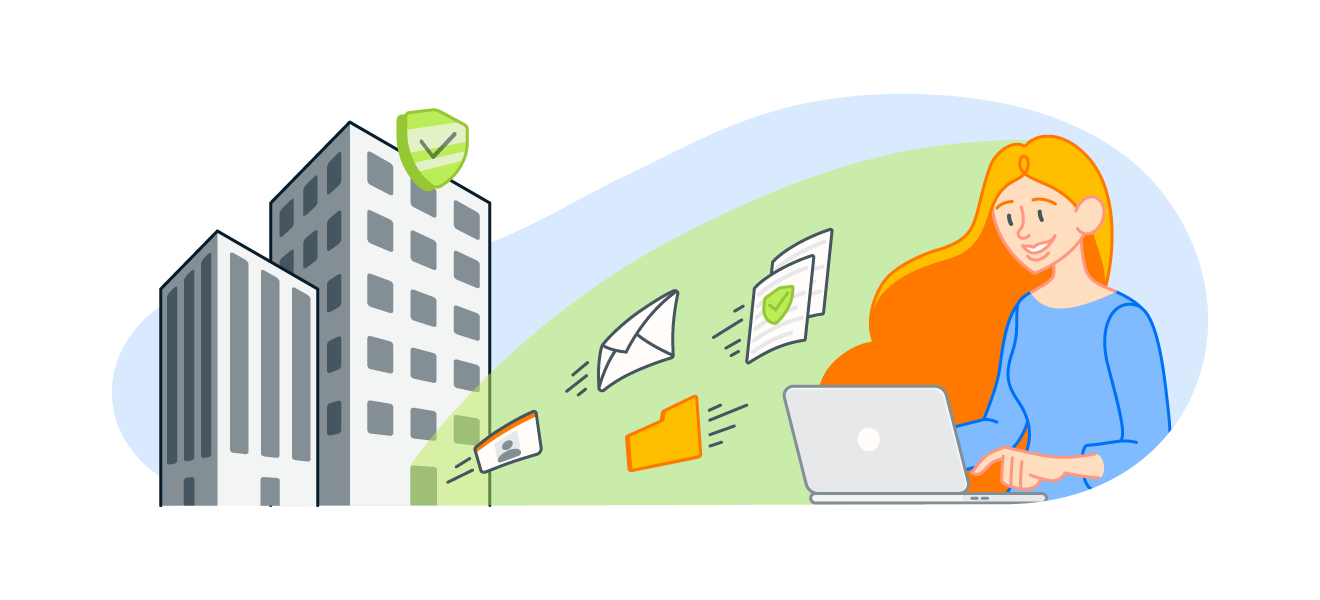 A company with SOC 2 compliance has met robust data protection requirements.
When an organization is SOC 2 compliant, it means it has demonstrated its ability to safeguard customer data in line with the Trust Services Criteria (TSC), which are a set of principles and control requirements that SOC 2 audits are based on. This allows customers and other organizations to know that when they interact with a SOC 2-compliant business, its data security has been independently verified and assured.
Perhaps confusingly, the acronym SOC can also refer to a Security Operations Center. In that context, it refers to a team that helps an organization monitor and respond to cyberthreats in real time.
Types of SOC 2 reports
There are two types of SOC 2 reports, both issued by independent firms accredited by the AICPA. Tailored to meet the varying needs of organizations, these reports differ based on the unique requirements and levels of assurance that each organization’s customers may demand.
SOC 2 Type I is designed to demonstrate that an organization has the proper security controls set up at a point in time, like a snapshot of its security posture. This can be useful for small startups that haven’t been around for long and need to prove their credentials to clients and customers quickly.
SOC 2 type II is more comprehensive and demonstrates that security controls exist and have been working consistently over a defined audit window (around 3-12 months).
If an incident like a data breach were to occur, Type I might prove you had an incident response plan in place, whereas Type II goes further and shows that you tested the plan over time, trained staff, logged incidents, and responded properly to the incident.
SOC 1, SOC 2 vs. SOC 3?
SOC 1 reports demonstrate an organization's controls for safeguarding a customer's financial statements. SOC 2 reports focus on the management of customer data. Similarly, SOC 3 reports cover the same criteria as SOC 2, but are designed for public disclosure.
We’ve covered SOC 2 in more detail already, so here’s an overview of SOC 1 and SOC 3:
SOC 1 compliance demonstrates that an organization has the correct controls in place to help prevent errors, misstatements, or fraud that could affect a customer's financial reporting. For example, a third-party payroll processor may pursue SOC 1 compliance to prove to potential clients that it can handle calculating and reporting salaries correctly, and not compromise the client’s financial statements.
SOC 3 is a report intended for general distribution and covers the same set of criteria as a SOC 2, but is simplified and doesn’t contain the same level of detail, test results, or evidence. Organizations obtain SOC 3 reports as a way to publicly demonstrate their compliance without providing sensitive details, and often share these reports publicly on their websites.
Many organizations will obtain a SOC 2 report, which they can usually share under an NDA to partners and potential customers, and a SOC 3 report, which they can make publicly available to build trust.
Here’s a table providing a summary of the differences between SOC 1, SOC 2, and SOC 3:
| Focus area | Typical candidates | |
|---|---|---|
| SOC 1 | Controls at a service organization that could impact a customer's financial statements. | Any organization dealing with information that could affect financial statements, such as payroll processors, loan servicers, payment processors, and accounting services. |
| SOC 2 | Data security, system reliability, and privacy practices. | Any organization that stores, processes, or manages customer data. Usually a third-party service like a cloud storage provider. |
| SOC 3 | The same areas as SOC 2. | The same organizations that are SOC 2 compliant, but also want a publicly shareable report they can use to signal trust to a broad audience. |
SOC 2 principles
We mentioned the Trust Services Criteria (TSC) earlier in the article, and these are the cornerstone of a SOC 2 audit. The AICPA created these criteria to evaluate how well organizations manage their customers' data.
Here’s a breakdown of the five categories in the Trust Services Criteria (TSC):
-
Security: You can think of security as the foundation of the SOC 2 report. Security covers authentication requirements such as 2FA and password policies, logical access controls like firewalls or an IDS, and endpoint security such as antivirus software. It also covers physical security like locked doors and access badges, as well as internal policies and security awareness training for employees.
-
Availability: This category relates to whether or not systems are operational and accessible when they need to be. Reliability, performance, and continuity are all aspects of availability.
-
Processing integrity: This concerns a system’s ability to process data accurately, efficiently, validly, completely, and with the right authorization. Processing integrity is something customers expect when they interact with a business.
-
Confidentiality: Refers to protecting sensitive information such as intellectual property, contract terms, and business plans. This criterion looks at who can access this confidential information, how it’s encrypted in transit and at rest, and whether it’s disposed of securely when no longer needed.
-
Privacy: This is all about sensitive Personally Identifiable Information (PII). Data such as names, addresses, and medical records are all classified as PII. This category assesses whether sensitive PII is protected against unauthorized users.
SOC 2 audits
SOC 2 compliance must be audited by a licensed CPA firm qualified to perform the audits under AICPA standards. These firms are authorized to provide professional attestation, sign, and issue a SOC 2 report once an audit has been completed — provided the organization has met at least the security criterion, along with any other TSC categories included in its audit scope.
Other information security and compliance frameworks, including PCI DSS and ISO 27001, have rigid requirements that specify exactly what security controls an organization must implement and how. SOC 2, on the other hand, is principle-based — it defines the TSC, and it’s up to each organization to determine how to meet the relevant criteria with its own policies, procedures, and technology.
To prepare for an audit, organizations often use a SOC 2 compliance checklist — a set of guidelines or steps to follow that help ensure nothing critical is overlooked before the audit takes place. This doesn’t replace an auditor’s work, but serves as a roadmap for aligning the organization's practices with SOC 2 requirements and streamlining the auditing process.
What steps do organizations have to take to become compliant?
SOC 2 compliance isn’t simply about checking off a list of haves or have-nots, it’s about proving an organization has designed and implemented secure practices that meet the TSC. The steps to achieve this differ for every organization, but here are some core areas that auditors look at:
-
Access controls: Any policy, procedure, or technical safeguard that ensures only authorized users can access sensitive data and systems. This falls under the security category of the TSC.
-
Change management: Processes for requesting, reviewing, approving, and implementing changes to IT systems, applications, and configurations. Solid change management prevents risky or unauthorized changes and falls under the processing integrity category of the TSC.
-
System operations: Ongoing activities that keep IT systems stable, secure, and available when needed. System operations relate to the availability and processing integrity categories of the TSC.
-
Mitigating risk: Processes to identify, assess, and reduce risks to information systems and data. This spans all areas of the TSC, but especially confidentiality and security, and is essential for a SOC 2 report.
SOC 2 certification
Once an auditor completes their report, the result doesn’t come back as a simple pass or fail. Instead, the results can be presented in a few different forms, depending on the type of SOC 2 audit and the professional opinion of the auditor.
Here are some of the different judgments that can be handed down after a SOC 2 audit:
-
Unqualified opinion: This is the ideal result and means that the auditor found the organization's controls to be suitably designed (type I) and/or operating effectively (type II) to meet the TSC.
-
Qualified opinion: Indicates that the auditor found that the SOC 2 requirements have generally been met, but with one or two exceptions that require attention.
-
Adverse opinion: This finding means the auditor found that the organization’s controls have not been adequately designed or are not operating effectively to meet the TSC. This is a negative outcome and can affect an organization's credibility.
-
Disclaimer of opinion: This means the auditor couldn’t gather sufficient evidence to form a fair conclusion. This can occur when there are significant limitations to the information available to the auditor, to the audit’s scope, or other constraints that arise.
Strengthen your security with Avast
Whether your focus is on becoming SOC 2 compliant or you want to strengthen your organization’s security posture, a unified security platform can make all the difference. Avast Business Hub can help protect your business data, safeguard customer information, and keep your network secure. Try Avast Business Hub for 30 days for free and save time and resources that you can put back into your business.
What customers say

More Security Articles

What Are Intrusion Detection Systems (IDS) and How Do They Work

What is SOC 2? Your Guide to SOC Certification and Compliance

What Is a Security Operations Center (SOC)?
%20-%20SMB/What-is-cybersecurity-Thumb.jpg)
What is cybersecurity?

What Is an IT Disaster Recovery Plan and Why Business Continuity Matters

What Is a Wildcard Certificate and How Does It Work?

Business Continuity Plan (BCP): What Is It and How to Make One

OPSEC: What Is It and How Does It Work?

What Is the Cyber Kill Chain and How Does It Work?
%20-%20SMB/How-to-Keep-Your-Facebook-Business-Page-Secure-Thumb.jpg)
How to Keep Your Facebook Business Page Secure
%20-%20SMB/What-is-a-data-breach-Thumb.jpg)
What Is a Data Breach?

What Is Cloud Security?
Business
Security
Harrison Gough
1-12-2025