- Security
- Privacy
- Performance
Security operations centers (SOCs) provide 24/7 protection for a business’s assets. In this article, we’ll explore how an SOC works, the benefits it offers, the key components of a successful SOC, and how you can boost your security management with software like Avast Business Hub.




This Article Contains
This Article Contains
What is an SOC and what does it do?
An SOC, or Security Operations Center, is an operational hub that provides around-the-clock monitoring, detection, and analysis of cybersecurity threats, enabling a business to respond to them in real time. SOCs are integral to an organization’s ability to prevent hackers from using exploits to gain access to confidential systems or information.
When you think of an SOC, you might picture a room full of people watching screens for anything that might indicate an attack. That's only part of the story, though. SOCs comprise people, processes, policies, and technology, all coming together to safeguard an organization's assets.
When learning about SOCs in cybersecurity, you may come across the acronym SOC 2 (System and Organization Controls 2), which is a framework auditors use to evaluate the effectiveness of an organization's security controls in relation to protecting customer data. The SOCs discussed in this article are completely different, and relate only to a business’s operational cyberdefenses.
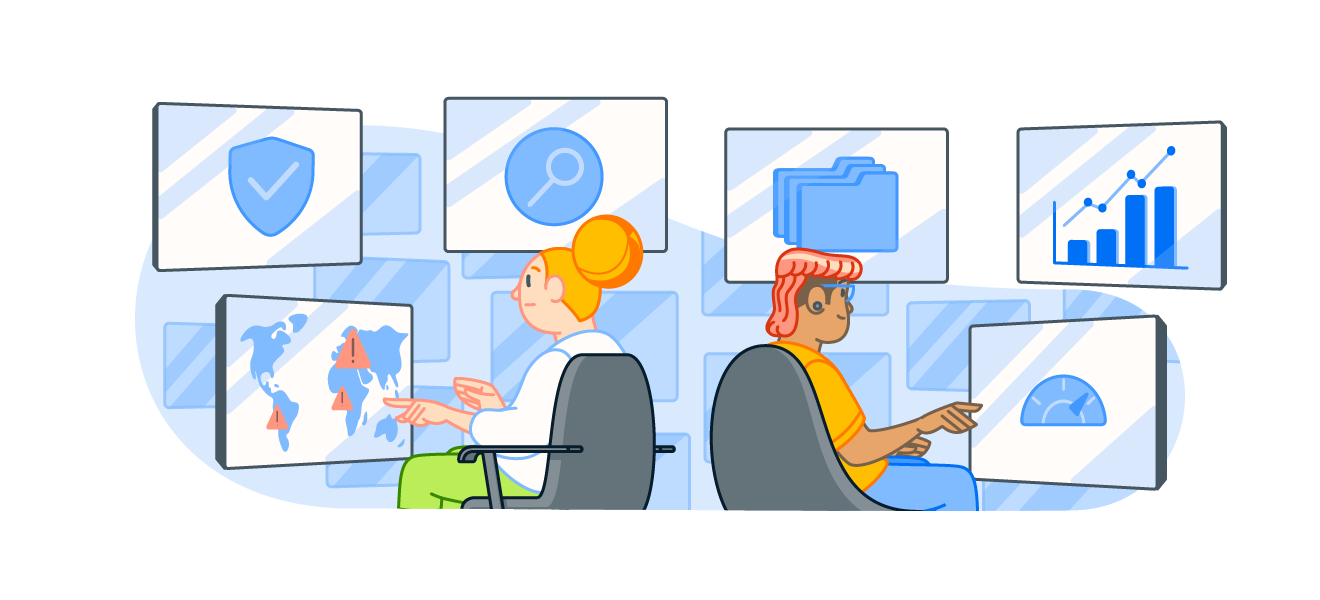 A SOC comprises multiple security resources and activities.
Other abbreviations you may have come across while learning about SOCs are CSOC (CyberSecurity Operations Center), CDC (Cyber Defence Center), and ISOC (Information Security Operations Center). These essentially provide the same service to an organization that an SOC does.
Let’s take a look at some of the key functions of an SOC:
1. Protection and prevention
To protect businesses and prevent attackers from accessing an organization’s confidential information, SOCs use a range of cybersecurity tactics, including:
-
Asset inventory. Maintaining a regularly updated inventory of an organization's IT assets is essential for an SOC to provide effective protection — after all, you can’t defend what you don’t know exists. Additionally, having a clear understanding of what needs protection allows for a quicker and more targeted response when a security breach or data breach occurs.
-
Protection tools to secure IT infrastructure. Security systems (like firewalls) and endpoint detection and response tools (like antivirus or anti-malware software) protect against malware (such as ransomware and other external attacks). On the other hand, monitoring tools help protect against insider threats and employee negligence.
-
Preventative security enforcement. An SOC enforces security processes for patching servers, cloud security, operational server security, and other IT assets by actively monitoring the asset inventory to align with security policies.
-
Routine testing. An SOC must frequently test its detection and response capabilities to ensure they work as intended. This includes incident response testing, vulnerability scans and penetration testing, detection and alerting tests, and cloud access testing.
2. Monitoring and detection
An SOC achieves its core mission of monitoring and detecting threats with a layered ecosystem of tools, including:
-
SIEM (Security Information and Events Management). A SIEM is essential for monitoring assets, as it aggregates and normalizes logs from different systems and endpoints into a central system. This helps the SOC process the data more effectively, enabling it to monitor and detect anomalous behavior.
-
XDR (Extended Detection and Response). Similar to SIEM, XDR monitors systems for threats. But unlike a SIEM, XDR can automatically respond to attacks based on how it correlates those attacks through methods such as blocking IPs, disabling user accounts, killing processes, or isolating hosts.
-
MDR (Managed Detection and Response). MDR is a managed service that monitors your organization’s assets. Security analysts use tools like SIEM or XDR to oversee the environment, acting as an outsourced SOC, which is ideal for organizations without an in-house team.
3. Threat response
How a cybersecurity operations center responds to threats is just as important as detecting them. The faster and more effective a response is, the more likely an attack will be contained or limited. Here’s how SOCs can respond to attacks:
-
Incident management. Incident management refers to the way an SOC team communicates, responds to, and recovers from attacks. It also includes reviews of incidents, so that your organization can learn important lessons and improve its security processes in the future.
-
Incident response. This is a subset of incident management that outlines the technical actions an SOC team takes when an incident occurs. This includes the immediate investigation of an incident, how you contain the incident, how you eradicate the threat, and how your organization’s assets recover.
-
Threat management. Of course, preventing incidents from happening in the first place is the ideal way to deal with threats. When this isn’t possible, making sure your organization is prepared for incidents when they do happen is the next best thing. Staying current with the threat landscape, prioritizing risks, and threat modeling are all ways to manage threats.
4. Remediation and recovery
From the SOC perspective, the process of remediation means removing an attacker's foothold in the system and fixing the vulnerabilities that allowed the attacker to gain access in the first place. Recovery is the process of bringing your business back to usual and ensuring systems are working as intended. Here are some of the ways an SOC achieves these goals:
-
Root cause investigations. Identifying the root cause is crucial in any investigation. You can’t fix what you don’t know is broken, and addressing the exploited vulnerability is the best way to prevent future attacks.
-
Process updates and incident response plans. Your organization needs to constantly improve security processes to keep up with evolving threats and attacks. Some of the ways an SOC can continuously improve to defend your organization’s IT assets include implementing SIEM logging rules and escalation workflows, identifying any policy gaps, and adjusting any response steps based on lessons learned.
-
Deliver awareness training. If security is everyone’s responsibility, then it’s critical that SOCs deliver awareness training on new (and old) attack vectors and that everyone understands how to escalate potential cyber threats to the SOC for investigation.
5. Compliance
Compliance in the world of information technology isn’t usually just an ideal — it’s a legal requirement, depending on your industry and the type of data your organization handles. An SOC can help your business abide by these standards and improve your security posture by collecting and storing logs for the amount of time specified by a certain standard (usually 1-7 years), and by reporting incidents within the timeframe outlined by the standard you are required to follow.
These standards drive security policy and help to protect sensitive customer data. Here are some of the common standards you may have heard of:
-
General Data Protection Regulation (GDPR)
-
Payment Card Industry Data Security Standards (PCI DSS)
-
Health Insurance Portability and Accountability Act (HIPAA)
-
California Consumer Privacy Act (CCPA)
-
International Organization for Standardization (ISO) 27001
Top benefits of using a Security Operations Center
There are many benefits of having an SOC take care of the constant monitoring, detection, prevention, and protection that modern organizations require. While SOCs don’t drive actual profit for a business, it’s hard to understate the value they provide. Here are some of the top benefits:
-
Closing security gaps in process and policy. An SOC can quickly identify security gaps in your organization’s policies and processes when conducting a post-incident investigation, enabling you to quickly remediate any problems and reduce any vulnerabilities.
-
Security awareness training. As the “boots on the ground” at the forefront of your organization’s security environment, SOCs have first-hand knowledge of what threats your organization is facing and how those vulnerabilities are usually exploited at different stages of the cyber kill chain. This positions SOCs as superior providers of effective awareness training to the rest of your organization.
-
Tool and tech enhancements. Cybersecurity is constantly evolving to keep up with new and emerging threats, as well as new ways to defeat these threats. As such, SOCs can help your organization by ensuring you stay on top of new technologies, tools, and methods that help to defend your organization’s assets.
SOC team: Who’s involved and what are their roles?
SOCs consist of a diverse team that not only monitors and detects threats but also manages them, handles post-incident remediation, and strengthens defenses to prevent future attacks. Let’s explore some of the key roles and responsibilities:
-
SOC managers. These managers ensure compliance within the SOC and liaise between upper management and SOC technical staff. They also provide escalation paths and oversee the staffing and operation of the SOC.
-
Cyber Threat Intelligence (CTI) managers. These individuals stay on top of the ever-changing threat landscape and collect valuable information about emerging threats so the SIEM and security analysts can detect and defend against them.
-
Security engineers. The job of a security engineer is to deploy, maintain, and keep improving upon the different technologies, tools, and infrastructure (such as SIEM, XDR, and logging agents) that SOC teams rely on.
-
Security analysts. As the frontline of defense for an organization, security analysts monitor logs for suspicious activity, discard false positives, and escalate any confirmed threats to the SOC manager.
-
Threat hunters. Working closely with CTI managers, threat hunters look beyond previous attacks and proactively search for hidden threats that traditional detection methods may have missed.
Protect your Security Operations Center with Avast
Keeping your SOC up to date with the latest tools is important for your business’s protection. Staying safer is easier with security solutions from Avast Business Hub, which is designed to enable remote management and monitoring from one streamlined dashboard. Get a demo or start your free trial today.
What customers say

More Security Articles

What Are Intrusion Detection Systems (IDS) and How Do They Work

What is SOC 2? Your Guide to SOC Certification and Compliance

What Is a Security Operations Center (SOC)?
%20-%20SMB/What-is-cybersecurity-Thumb.jpg)
What is cybersecurity?

What Is an IT Disaster Recovery Plan and Why Business Continuity Matters

What Is a Wildcard Certificate and How Does It Work?

Business Continuity Plan (BCP): What Is It and How to Make One

OPSEC: What Is It and How Does It Work?

What Is the Cyber Kill Chain and How Does It Work?
%20-%20SMB/How-to-Keep-Your-Facebook-Business-Page-Secure-Thumb.jpg)
How to Keep Your Facebook Business Page Secure
%20-%20SMB/What-is-a-data-breach-Thumb.jpg)
What Is a Data Breach?

What Is Cloud Security?
Business
Security
Harrison Gough
1-12-2025