- Security
- Privacy
- Performance
As AI reshapes everything from how you work to how you shop, it's also infiltrating one of the most intimate parts of your life. Now, the stakes for dating are even more complicated. AI is being used as a weapon by scammers, as a wingman by daters, and increasingly, as a potential romantic partner.


 Contains AI modified or generated content.

This Article Contains
This Article Contains
Key takeaways
-
35% of dating app users would consider using AI to hold a conversation with a match on their behalf: Along with that, nearly half (47%) of dating app users would consider using AI to write a pickup line.
-
As far as considering a romantic relationship with an AI chatbot, 8% said they would: Of those who would consider a romantic relationship with an AI chatbot, 94% say they’re serious about it, not just curious.
- Average losses for dating app users who have fallen victim to a dating scam are $1,112: Avast found that 17% of dating app users said they have fallen victim to a dating scam. Scammers are increasingly using AI-generated profiles, synthetic voices, and deepfakes to make fraud more convincing and harder to detect.
Cupid used to just have arrows. Now he has algorithms that amplify both the convenience of online dating, and heightened feelings of loneliness during the holiday season. As pressure to couple up intensifies during cuffing season and scammers sharpen their tools, here's what you need to know about AI in the dating app era, and more importantly, how to protect yourself.
The dating landscape now that AI is involved
Dating apps are now the default way to meet someone, if not in the wild. In fact, Avast research from a fall 2026 survey in 12 countries found that over one-third (35%) of people have used an online dating app or service. Highest among those, Gen Z was at 48% and Millennials just behind that at 46%, Gen X (26%) and Baby Boomers (13%) on the lower end.
What’s changed over the years is that AI is now embedded in almost every step of writing profiles, enhancing photos, vetting matches, and even, for a growing minority, replacing the whole experience with a chatbot. Here are three big things to consider when it comes to how artificial intelligence shapes your algorithm and staying safe when dating online.
AI can be used as a weapon for romance scams
The scam problem is real, and you need to start by confronting the ugly truth that dating app fraud is rampant, expensive, and AI is seemingly making it much worse. The numbers are staggering, as 28% of dating app users have been targeted by a dating scam and 33% have been pressured by someone they met through an online service to send money. Of those targeted, 59% unfortunately fell for it, which translates to about 3 out of 5 becoming victims.
If you have fallen victim, the price tag can be brutal: 79% of dating scam victims lost money, and among them the average loss was $1,112, so these aren’t abstract statistics, but real money, real heartbreak, and real financial damage.
The top dating scam types victims reported falling for were:
-
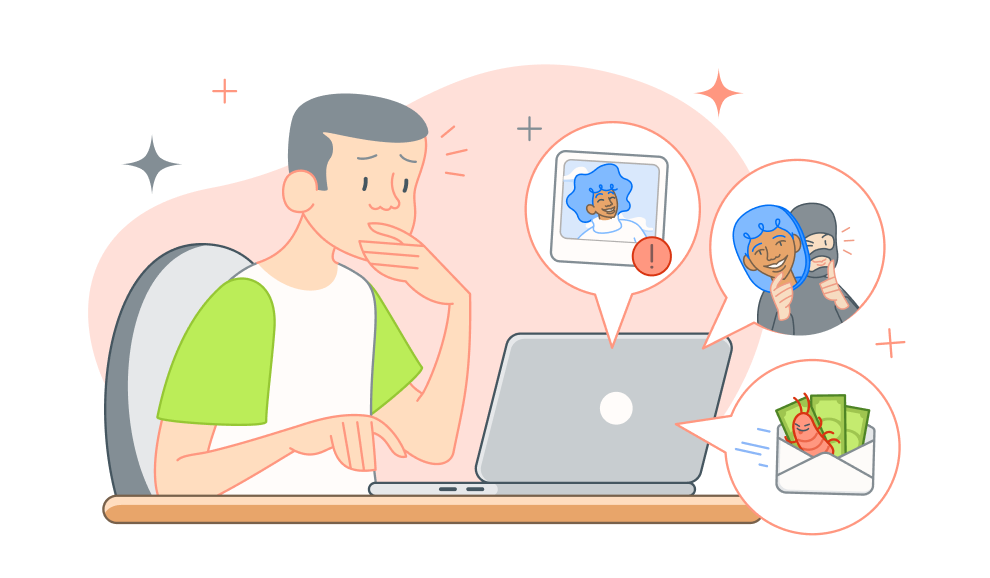
Catfishing (38%): Catfishing refers to fake profiles with stolen photos, often AI-generated or enhanced to look more attractive.
-
Photo scams (31%): AI-enhanced or completely fabricated images to establish false intimacy.
-
Fake dating site scams (29%): Fraudulent platforms designed to trick users into giving money or personal information, often using fake profiles and emotional manipulation
-
Sugar daddy or sugar baby schemes (28%): Sugar daddy scams are promises of financial support that require money up-front.
-
Malware scams (23%): Malicious links designed to spread malware on your device.
AI could be used as a dating assistant
Like having a friend as a wingman when meeting people at bars, daters today are open to using AI as a dating assistant. Here are a few key takeaways from ways daters would consider using AI when meeting people:
-
41% would consider using AI to screen or vet a match. This is higher among Gen Z and Millennials, both at 44%.
-
41% would consider using AI to develop their dating profile. For perspective, Millennials were at 45%, Gen X at 34%, and Baby Boomers at 20%.
-
40% would consider using AI apps or tools for dating coaching, which was higher among Gen Z (44%).
-
40% would consider having an AI therapy session for heartbreak. Of those, 47% were Gen Z, 42% Millennials, 31% Gen X, and 11% were Baby Boomers.
Here’s where it gets a bit more involved when it comes to what people would be willing to try.
-
33% would consider using an AI avatar to go on virtual dates as their proxy.
-
35% of dating app users would consider having AI have a conversation with a match on their behalf.
-
47% would consider using AI to write a pickup line or a conversation starter for dating apps.
-
43% would consider using AI to write a breakup text for them. The numbers are pretty high for this one as 49% of Gen Z, 46% of Millennials, 34% of Gen X, and 16% of Baby Boomers would do this.
When AI is potentially involved in this way, it could lead to AI dating AI if both sides are doing the same thing.
AI could become a romantic partner for some
Watching any science fiction might sway most people away from dating a bot, but a portion of the population is genuinely considering, or already pursuing, romantic relationships with AI.
In fact, 8% would consider a romantic relationship with an AI chatbot: within that stat, it’s 14% of Gen Z, 11% of Millennials, 10% of men, and 7% of women.
Among the 8% who would consider a romantic relationship with an AI chatbot, 31% said it might be easier than dating a human. When pressed further about their reasoning, curiosity leads overall (34%), while 33% are interested in technology and want to see how far it could go, and 30% want to feel understood without judgment.
However, don’t forget, even with this method, people are still going to vary widely in how seriously they take something, or how much they are willing to emotionally invest in dating. For example, of those who would consider a romantic relationship with an AI chatbot, 94% would take it seriously, but only 62% of those would consider it a real relationship.
Why the holidays create the perfect conditions for romance scams
The holidays supercharge all three dynamics, especially since the holiday season can urgently highlight feelings of loneliness and depression. For instance, Avast’s research found nearly one in five people surveyed feel additional pressure to be in a romantic relationship around the holiday season. Potentially more dangerous, 44% of those feeling holiday pressure say it makes them more willing to take risks with people they meet online.
Unfortunately, that's when scammers strike. During the most recent holiday season, 52% of dating app users received at least one suspicious item from a match such as a link, QR code, shared album, group call invitation, or file to open. Now it seems that AI knows how to emotionally manipulate, because of those whose dating match sent them something suspicious, 33% found it harder to challenge or refuse because they didn’t want to lose the chance to meet or speak during the holidays, and 32% did not want to seem rude during a festive occasion.
Why is it so hard to say no, especially when doing so could protect you from potential scams? Here is what some other dating app users had to say:
-
The request was time-sensitive: 31%
-
Didn’t want to spoil the mood: 30%
-
Didn’t want to seem paranoid: 25%
The reality check of protecting your heart and your wallet
Yes, AI has made dating more efficient, more accessible, and, subsequently, often more dangerous. Scammers are using it to fabricate entire personas. Daters are using it to optimize their own profiles and vet matches, or even design their own partner. However, with so much murkiness in the dating waters, outside of looking someone up on social media or telling a friend about your plans before you meet up with someone, what can you do to take precautions?
To start, here's your dating app security checklist you can go over before dipping your toe in the dating pool:
-
Treat urgency as a red flag: Time-sensitive requests are a classic scam tactic. Real connections don’t require rush decisions.
-
Verify links before clicking: Your options include previewing the full URL destination, inspecting the domain name, or using a URL scanner and antivirus protection tool. Don’t click unless you feel certain the link is legitimate.
-
Heed device warnings: Your phone, email provider, or dating platform’s security system exists for a reason. If it flags something, that’s not paranoia — it’s protection.
-
Never send money to someone you haven’t met in person: This should be obvious, but scammers are smooth talkers. No legitimate match will ask for money before meeting.
-
Video call to confirm it’s a person. If someone refuses a live video call before meeting, that’s a bad sign. Real people can prove they’re real, helping you protect yourself and helping to keep your personal information safer.
-
Enlist help to protect yourself: Avast Free Antivirus gives you scam protection built around how you live online. You can get an extra layer of protection that will help detect and isolate potential cyberthreats. The AI-powered Avast Assistant will also check suspicious messages and offers, strengthening your defenses against scams.
What customers say

More Privacy Articles
Love, Lies, and Algorithms: Dating in the Age of AI

What Is VoIP and How Does It Work?
Is TikTok Shop Safe and Legit?

Is AliExpress Legit? How to Buy From AliExpress Safely

The Dangers of Artificial Intelligence: What You Need to Know
Generative AI Defined: What It Means & How It Works
What Is Blockchain Technology And How Does It Work?

Artificial Intelligence Defined: What Is AI and How Does It Work?
Different Types of Artificial Intelligence (AI) You Need to Know

Has My Number Been Blocked? 5 Ways You Can Tell

Is Temu Legit or a Scam? What You Need to Know to Stay Safe
What Does 5G UC Mean on Android & iPhone?
Digital Life
Privacy
Caitlyn Moorhead
12-11-2026