- Security
- Privacy
- Performance
The Nigerian Prince scam is alive and well. Known as a “419 scam” to law enforcement, this long-running fraud tricks victims into sending money to criminals posing as wealthy foreign dignitaries in need of help. In this guide, we’ll break down how the scam works, the warning signs to watch for, and how Avast Free Antivirus can help protect you from scams and other threats.







This Article Contains
This Article Contains
What does “419” mean?
The legal code “419” refers to advance-fee fraud, which is the type of scheme that the Nigerian Prince scam falls under. In this specific type of 419 fraud, a criminal poses as a wealthy but distressed individual who needs an advance deposit to unlock a much larger fortune. Although this online scam dates back to the early days of email, it continues to cause financial harm today.
The origins and history of the Nigerian Prince scam
The Nigerian Prince scam has become shorthand for online fraud, but its roots predate the internet. Long before personal computers were common, scammers used postal letters to extract money from unsuspecting victims. Email simply gave criminals something new: instant, global reach at virtually no cost.
While many variations of advance-fee fraud exist, the “Nigerian Prince” storyline became so widespread in the late 1990s and early 2000s that it came to represent the entire category.
How the scam evolved and common variations
In its classic form, the scam involved mass emails from someone claiming to be Nigerian royalty with millions of dollars trapped in a foreign bank account — supposedly inaccessible without a relatively small upfront payment. In exchange for covering the “transfer fees,” the recipient was promised 10–30% of the total sum.
Today, criminals use a wide range of narratives to solicit advance payments. Common variations include:
-
Inheritance claims.
-
Lottery or sweepstakes winnings.
-
“Sugar daddy” arrangements.
-
Fake investment opportunities.
-
Romance-based financial emergencies.
In each case, the structure remains the same: the victim pays a fee to “unlock” a large payout, but the promised money never arrives.
However, email is no longer the primary channel for these scams. Modern 419 fraud is now committed mainly through social media, messaging apps, dating platforms, and phone calls. With low-cost AI tools readily available, criminals are increasingly automating deepfake-driven impersonation and voice phishing attacks, and crafting more convincing messages at scale.
How the Nigerian Prince scam works
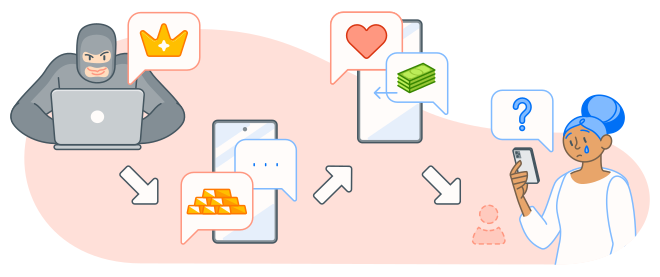
Whether the story involves a Nigerian prince, a wealthy widow, or an unexpected inheritance, the mechanics of advance-fee fraud are remarkably consistent. Most schemes follow a predictable pattern:
-
Contact: Professional scammers rarely wait for victims to approach them. They initiate contact through email, social media, messaging apps, or phone calls — casting a wide net to find receptive targets.
-
Story: Scammers craft narratives designed to trigger emotions ranging from urgency, sympathy, excitement, and even flattery. The promise of a large reward lowers skepticism and encourages engagement.
-
Request: After establishing rapport, the scammer asks for something upfront: a transfer fee, a processing charge, or sensitive financial information. In some cases, this request comes quickly. In others, it may take months or even years.
-
Escalation: Once a victim complies, scammers rarely stop at a single payment. They invent additional obstacles — taxes, bribes, legal fees, administrative charges — each requiring another transfer.
-
Disappearance: Whether the victim sends one payment or many, most 419 scammers eventually vanish. The promised fortune never materializes, and communication abruptly ends.
Psychological tactics used by scammers
As professional social engineers, scammers are skilled psychological manipulators. They make their living by identifying and exploiting greed, kindness, fear, and empathy to override rational thinking.
First, they build credibility through detail and persistence. Fraudsters may use official-looking documents, write with formal language, or piece together personal information gathered from data breaches to appear legitimate. Over time, they establish rapport and trust, gradually escalating requests.
Then, they promise a large reward, threaten legal trouble, or advance another pretext to create emotional pressure — excitement, panic, or curiosity — pushing victims to act quickly before they have time to verify the story.
As the journalist and novelist Walter Kirn wrote of his experience falling prey to a scammer (who ended up being a cold-blooded murderer), “[The scammer] lived in two modes, the apparent and the veiled, and in two realms, the opera and the sewer, and he shuttled between them like a genie.”
Typical red flags in scam emails and messages
Watch for these common scam warning signs in emails, texts, social media messages, and phone calls:
-
 Unsolicited contact.
 -
Promises of large rewards for minimal effort.
-
Requests for upfront fees or sensitive personal data.
-
Pressure tactics, creating urgency or demands for secrecy.
-
Suspicious sender addresses or unfamiliar links.
-
Generic greetings or awkward, unnatural phrasing.
On their own, any one of these may seem harmless. Together, they signal risk. Curious what this looks like in practice? Here’s an example of how an advance-fee scam message might look:

Scammers often misspell words or use awkward phrasing on purpose. If a message were polished enough to convince everyone, they’d be overwhelmed responding to skeptics and casual replies. Instead, obvious errors act as a filter — screening for people who are more likely to suspend disbelief and engage.
That said, not all scam messages are sloppy. Some are highly sophisticated and carefully tailored to specific individuals. But whether crude or carefully crafted, scams work because they target human emotion. So keep the red flags in mind — anyone can be deceived under the right circumstances.
What to Do If You’ve Been Targeted by a Nigerian Scam
If you’ve been targeted by a Nigerian prince scam, the right response depends on whether you’ve only received a message or already sent money or shared information.
If the message hasn’t progressed beyond initial contact, act quickly but calmly:
-
Do not reply, click links, or open attachments. Engagement confirms your address is active.
-
Mark the message as spam or phishing to help your provider filter similar attempts.
-
Block the sender to cut off further contact.
-
Report the scam through your email provider and relevant consumer protection channels.
But if you’ve transferred funds or disclosed sensitive data, you need to act swiftly to prevent further financial losses and limit your exposure to identity theft:
-
Contact your bank or payment provider immediately. Ask about reversing the transaction or flagging fraud.
-
Change passwords for your email, banking, and any related accounts.
-
Enable two-factor authentication (2FA) wherever possible.
-
Monitor your accounts closely for unauthorized activity.
-
Report the incident to the appropriate authorities and consumer protection agencies.
-
Be alert for “recovery scams.” Fraudsters often target victims again, claiming they can retrieve lost funds for a fee.
How to protect yourself from potential scams
Reducing your risk starts with simple, repeatable habits. Keep these best practices in mind:
-
Be skeptical of unsolicited financial offers.
-
Independently verify the identity of anyone you “meet” online.
-
Never send money to supposedly release funds.
-
Use strong, unique passwords and enable 2FA.
-
Keep your software and devices updated.
-
Rely on spam filters and anti-phishing protection.
-
Use an antivirus program to protect against malware and dangerous links.
Protect yourself from online scams
As scammers increasingly use AI to scale and refine their attacks, proactive protection matters more than ever. For added defense against phishing, malicious links, and emerging threats, choose Avast Free Antivirus for a powerful security solution with built-in scam protection. Get it now to reduce your exposure to common scam tactics while browsing, emailing, and messaging.
FAQs
Can you get in trouble for replying to a Nigerian Prince scam?
Simply replying to a Nigerian Prince scam is not illegal. However, engaging can escalate the situation. If you send money, you will almost certainly lose it. In more extreme cases, scammers may attempt to involve victims in illegal activity — such as transporting packages or funds. Even if you’re unaware of the full scheme, participating can carry serious legal and personal consequences.
Why people still fall for Nigerian Prince scams
People still fall for Nigerian Prince scams because they rely on a refined psychological playbook. Criminals use emotional triggers, personalized details drawn from public or leaked data, and carefully paced trust-building to lower defenses.
Shame and social isolation also play a role. Victims may hesitate to seek a second opinion, especially if the scammer has framed the opportunity as confidential or urgent. The manipulation works not because people are careless, but because they’re human.
What are scams similar to the “419” scam?
Advance-fee fraud comes in many forms. The storyline may feature a wealthy widow, a detained executive, a foreign official, or a sudden inheritance. Some versions revolve around lottery winnings, investment windfalls, or emergency financial requests from online romantic partners.
How is AI changing scam emails?
AI has made scam operations more efficient and more convincing. Criminals now use AI tools to generate polished, personalized messages at scale — often free of the spelling errors that once served as obvious warning signs. AI can also help scammers analyze public data, mimic writing styles, and automate conversations, making interactions feel more natural and responsive. The result is higher volume, greater personalization, and fewer visible red flags.
What customers say

More Security Articles

How To Work With Your Grandparents To Keep Them Safe From Scams

Grindr Scams: How to Spot Sextortion and Stay Safe

Brushing Scams: What Are They and How Do They Work?

What is the Nigerian Prince scam?

Block Mobile Scams Instantly with AI-Powered Scam Guardian Pro

How to Avoid eBay Scams: A Comprehensive Guide

How to Spot and Avoid Fake Emails Supposedly from Avast

Is Ticketmaster Legit?

Scam Likely Calls: What Are They and How Can You Block Them
Signal App Scams: How to Identify Them and Protect Yourself

How to Spot and Avoid Airbnb Scams

Facebook Marketplace Scams & How to Avoid Them
Scams
Security
Adam De Gree
17-03-2026