- Security
- Privacy
- Performance
Avast Safe Tech Report 2026
How People Around the World Respond to Digital Scams
Online scams continue to pose a significant global cybercrime threat, costing victims both money and peace of mind. Avast surveyed more than 13,000 adults across 12 countries to better understand how people encounter, experience, and respond to online scams. This edition of the Avast Safe Tech Report explores the latest scam statistics, common fraud tactics, and how scam experiences differ across generations and countries — patterns also visible in the Fearless Planet Index, a live view of global cyberthreat activity from Gen Threat Labs, supporting the company’s mission to build a Fearless Planet.
Scams are still a serious and costly digital threat

Does widespread scam awareness help people avoid scams?
The types of scams people are falling for most
The types of scams people are falling for most
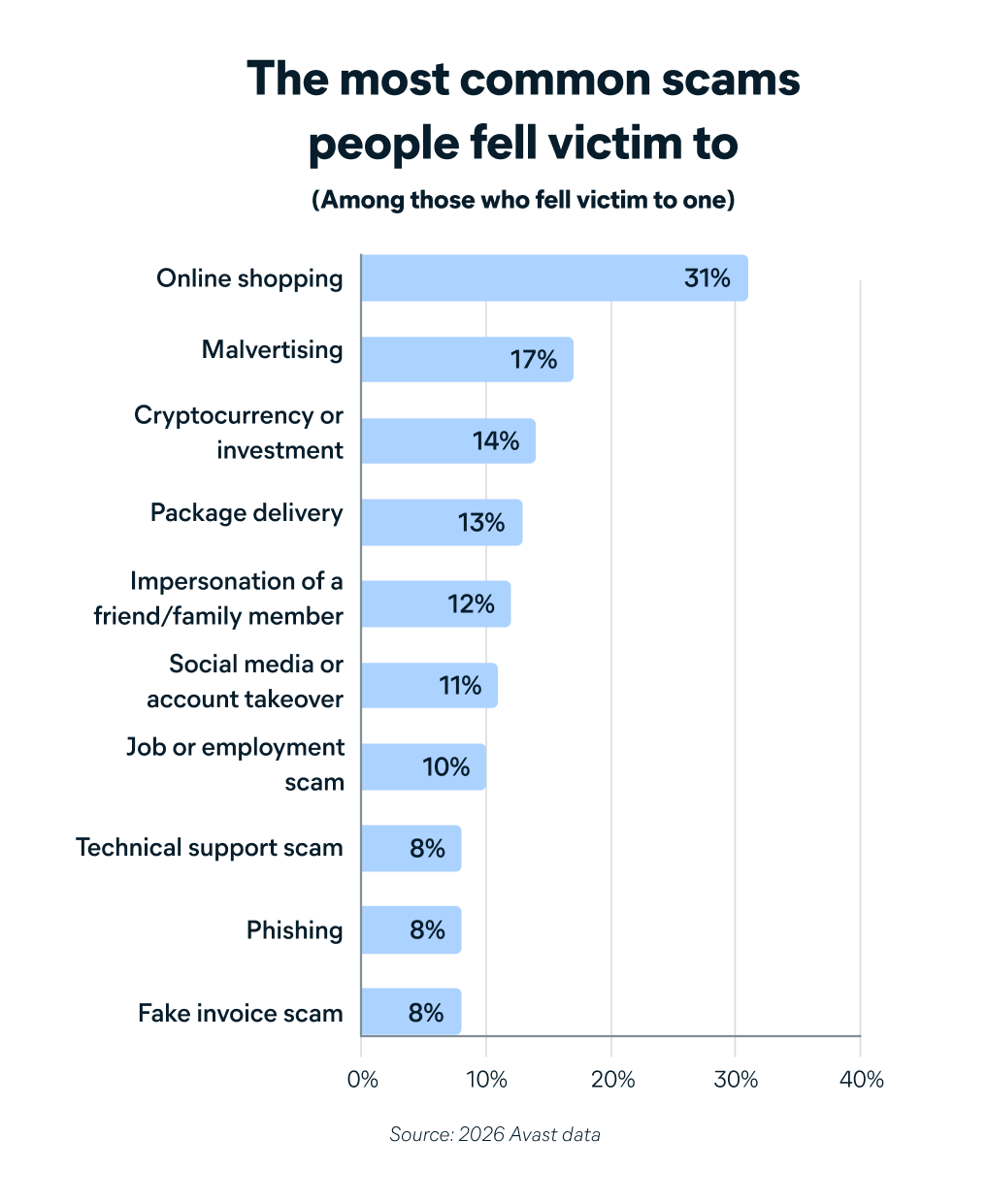
The scams people encounter the most aren’t always the ones that work. Classic phishing is a good example. Our research shows it’s among the most commonly encountered scam types, and it's also one of the threat types Gen products, including Avast One, block most often, according to our Fearless Planet Index.
However, according to our survey data, the scams people fall for most often include online shopping scams (31% of scam victims), malvertising (17%), crypto or investment scams (14%), package delivery (13%), impersonation of a friend or family member (12%), and social media or account takeovers (11%).
How scams affect each generation differently
Gen Z
Millennials
Baby Boomers



-
33% of Gen Z reported being targeted by an online scam in the past 12 months.
-
20% of Gen Z reported falling victim to an online scam in the past 12 months.
-
12% of Gen Z reported losing money to a scam.
-
23% of Gen Z reported they are unlikely to quickly tell someone close to them if they lost money to an online scam.
-
28% of Millennials report being targeted by an online scam in the past 12 months.
-
14% of Millennials reported falling victim to a scam in the past 12 months.
-
9% of Millennials reported losing money to a scam.
-
19% of all Millennials reported they are unlikely to quickly tell someone close to them if they lost money to an online scam.
-
17% of Baby Boomers reported being targeted by an online scam in the past 12 months.
-
6% of Baby Boomers reported falling victim to an online scam in the past 12 months.
-
4% of Baby Boomers reported losing money to a scam.
-
10% of all Baby Boomers reported they are unlikely to quickly tell someone close to them if they lost money to an online scam.
People are concerned about elderly loved ones falling for scams
However, there are some simple and effective ways to prevent fraud and scams against the elderly as long as you know where to start. For example, 67% of those surveyed (who have elderly loved ones) told us that having a simple conversation or taking action with their elderly loved ones helped them steer clear of fraud or avoid a scam altogether.
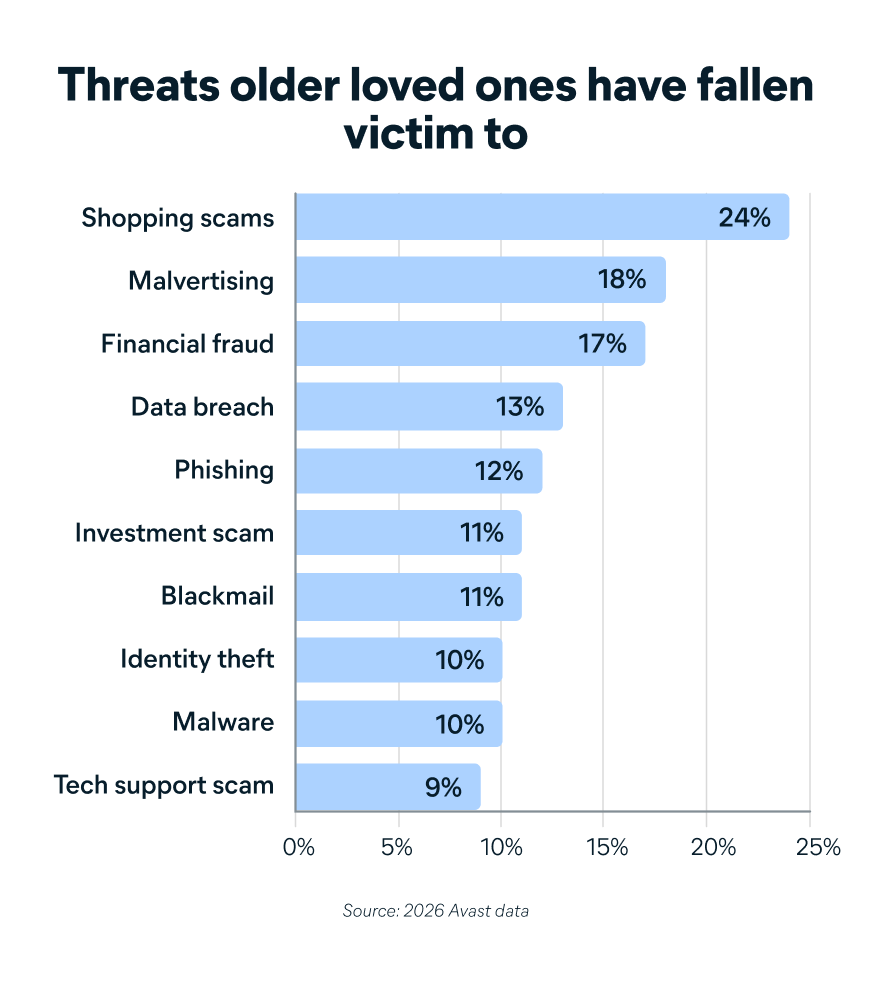
68% of adults with older loved ones say one has fallen victim to a scam, identity theft, or fraud at some point. Among those with older relatives, 24% reported their older loved ones falling victim to a shopping scam, 18% to malvertising, 17% to financial fraud, 13% to data breaches, and 12% to phishing scams.
How people respond to scams
When it comes to losing money to an online scam, 68% of the people we asked said they would quickly tell someone close to them if they fell victim. That being said, once they realize they were scammed, the behaviors of most people ultimately shape how scams stay hidden.
What red flags do people dismiss?
What red flags do people dismiss?
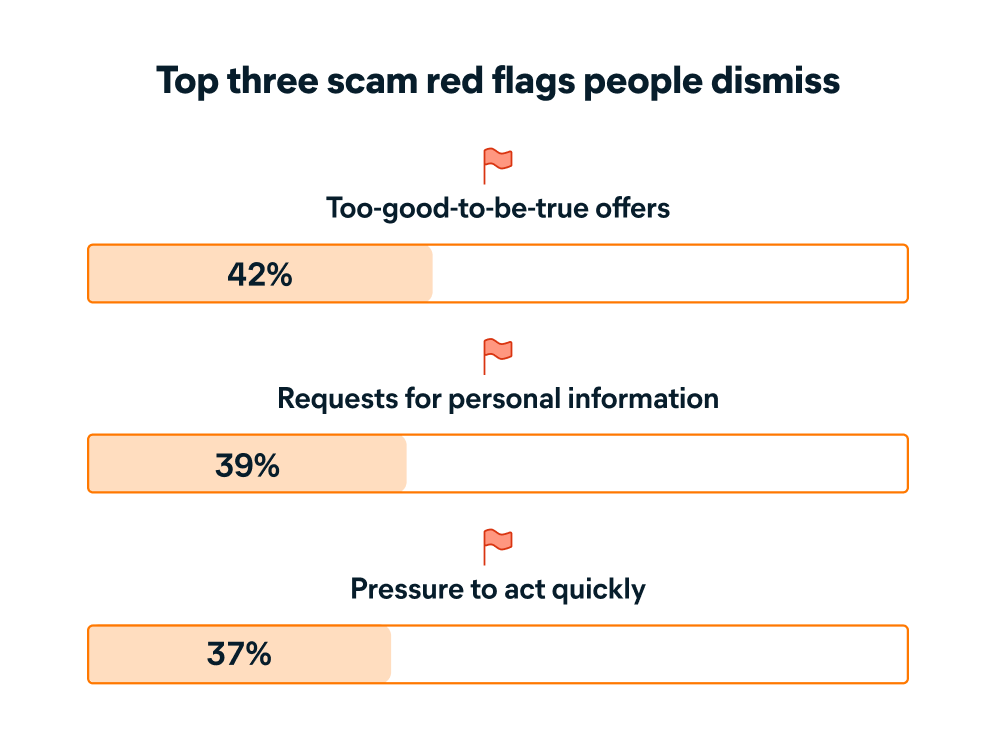
“Red flags” should make people want to pause and exercise caution. Yet, globally, people reported many classic red flags as easy to dismiss in the moment, especially offers considered “too-good-to-be-true” or requests for personal information with added pressure to act quickly.
What do people do when they receive something that feels suspicious?
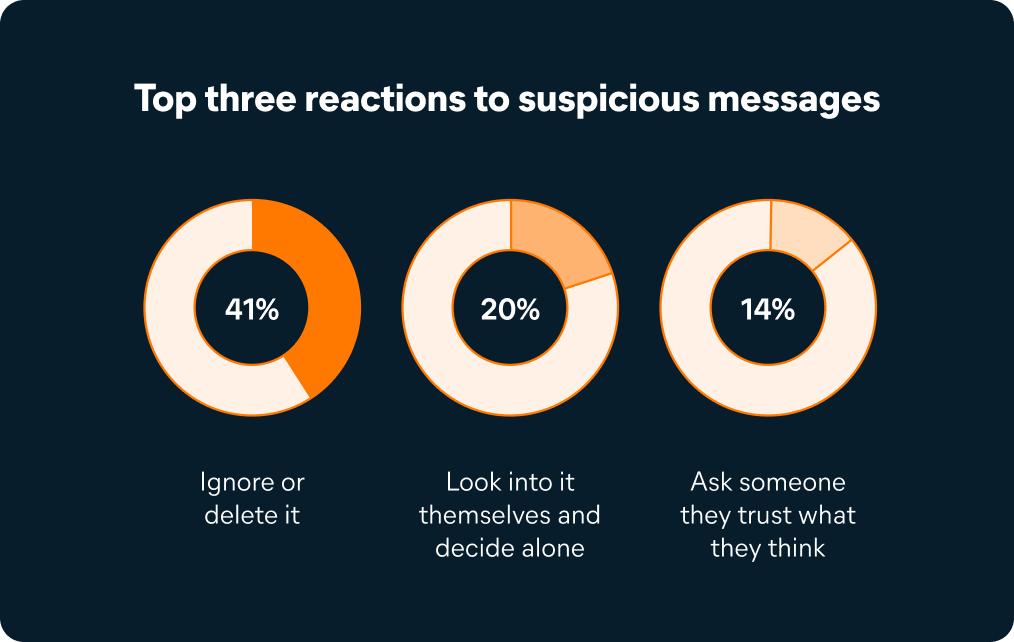
What do people do when they receive something that feels suspicious?
When people get a message, call, or link that triggers their scam radar, many feel confident enough to deal with it on their own: 41% of adults ignore or delete suspicious messages without mentioning them, and 20% investigate them themselves.
Who do people turn to when they have been scammed?
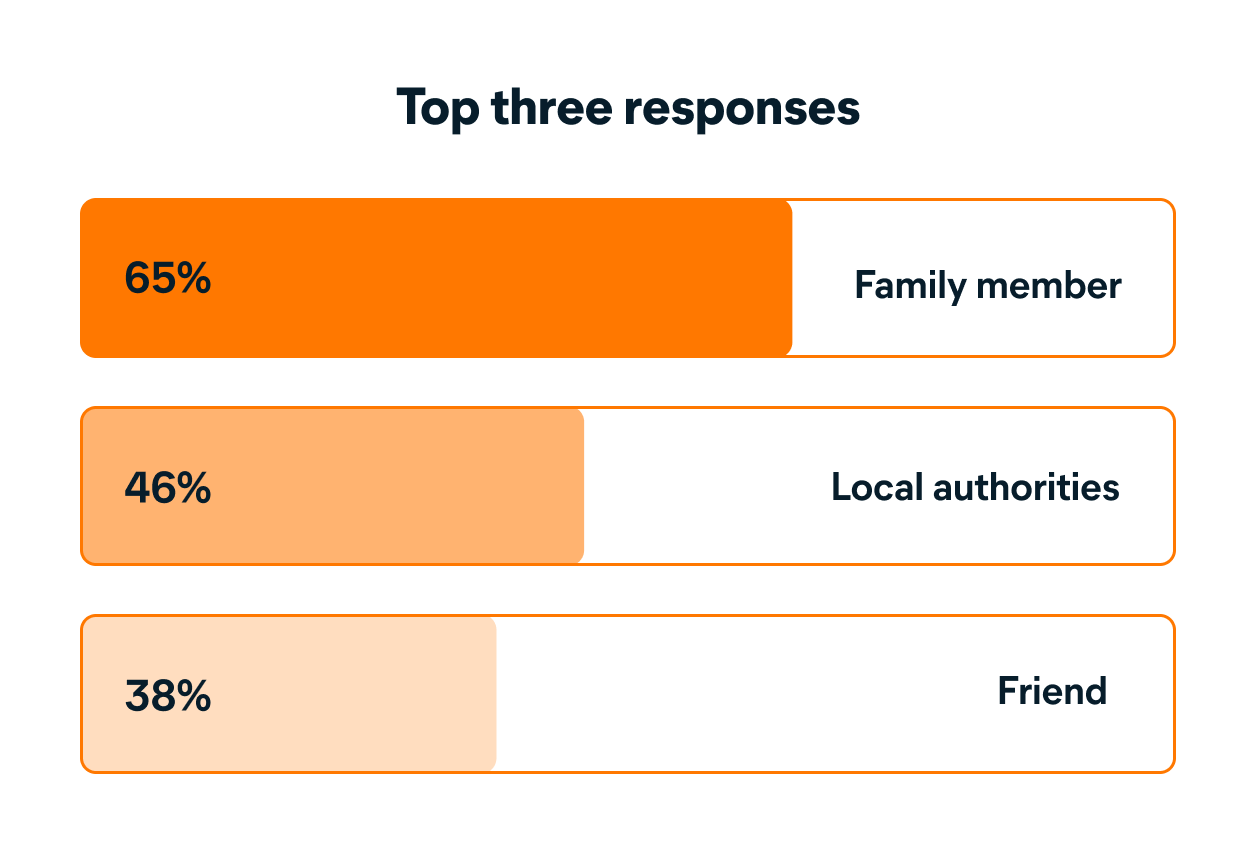
Who do people turn to when they have been scammed?
Most adults are likely to tell their families after falling victim to a scam, even over local authorities. However, that gap disappears almost entirely when someone falls victim to a serious privacy breach, in which case 55% of adults would tell local authorities, and 54% would tell a family member.
Are people prepared to deal with AI cyberthreats?
Where are people most likely to fall victim to a scam?

The global scam landscape across 12 countries

-
Romance scams reached 16% of targeted U.S. adults, double the global rate of 8%.
-
Among U.S. adults targeted by a scam, 28% met a fake invoice and 21% an unpaid toll demand — against 18% and 12% globally.
-
69% of Americans are confident they could spot AI-generated or manipulated content.
U.S.A.
Just over one in four U.S. adults (26%) were confronted with an online scam in the past year, and 12% of all American respondents fell for one. Among Americans who were targeted, fake invoices, unpaid tolls, account takeovers and romance scams all ran well above global levels.
Americans are relatively confident that they can spot fabricated content, with 69% claiming they could spot AI-generated content (compared to 56% globally). They’re also candid about their own lack of scam-spotting abilities in general. 23% admit that any common scammer’s red flag could realistically catch them out. Among U.S. adults who were financially impacted, the average reported loss was $3,189.

-
Only 6% of UK adults say they fell for a scam last year, less than half the global rate of 13%.
-
Phishing is a British scam staple, reaching 33% of targeted UK adults against 19% globally.
-
78% of Brits would tell someone close to them straight away if they lost money to a scam, making them among the most forthcoming in our study.
UK
British consumers are approached by scammers about as often as anywhere, but they fall victim far less. Roughly one-quarter of British adults (23%) encountered a scam last year, but just 6% fell for one, and only 5% lost money. Phishing (33%) and package delivery scams (34%) dominate what Britons encounter; online shopping scams are what UK victims most often fell for (28%).
After a scam, 78% said they would quickly tell someone close to them if they lost money to a scam, which is a fair bit higher than the 68% globally who said the same. UK respondents also seem relatively unconcerned about AI fooling them: 70% are confident they could tell genuine content from something AI-generated, versus 56% worldwide. However, 45% of Brits have ever shared, or considered sharing, personal or work documents with a chatbot.

-
Almost everyone in Brazil approached by a scammer was taken in: 88% of targeted adults fell for a scam, against 50% globally.
-
Online shopping scams reached 45% of targeted Brazilians, one of the highest shares of the 12 markets.
-
44% of Brazilians whose older relative was scammed say it arrived by WhatsApp, compared to 24% globally.
Brazil
Brazil has the widest gap anywhere between encountering a scam and falling for it. Only 20% of adults met a scam last year, below the global average, yet 88% of those who encountered one fell for it, the highest rate in the study. That leaves 18% of all Brazilian respondents as victims and 13% financially impacted.
Scam awareness isn’t the problem, with 94% of adults saying they follow documentaries, podcasts, or series about scams, and 86% of those with older loved ones saying a conversation helped one avoid a scam. Both of these figures are well above global levels. WhatsApp is a major reported scam vector in Brazil: 44% of Brazilians whose older relative was scammed point to WhatsApp, against 24% globally.

-
28% of Colombian adults fell for a scam last year and 17% lost money — among the highest of all markets on both counts.
-
Malicious advertising reached 49% of targeted Colombians, twice the global rate of 25%.
-
63% of Colombians who saw something about scams in the media have used it to start a conversation with a loved one, among the highest of any market.
Colombia
Online scams hit Colombia harder than any other market in the study. More than half of adults encountered a scam last year, 28% fell for a scam, and 17% lost money. Malicious advertising is a defining channel, reaching nearly half of everyone targeted.
Colombians talk about scams a lot: 96% have seen or heard something about them, 63% of that group turned that into a conversation, and 54% would report a scam to the authorities.

-
88% of Chilean adults with older loved ones say something they said or did helped a loved one avoid a scam — among the highest in the study, against 67% globally.
-
75% would turn to family after being scammed, and just 1% would tell nobody.
-
Malicious advertising reached 39% of targeted Chileans, against 25% globally.
Chile
Chile combines heavy scam exposure with a strong response at home: 44% of adults encountered a scam last year, and 20% fell for one. Malicious advertising (39%) and online shopping scams (35%) are the two biggest threats.
97% of Chileans have heard something about scams in the news, on social networks, or in other media — among the highest of any market. When scams occur, family is the first call for 75% of Chileans, and only 1% would keep it to themselves.

-
Just 15% of French adults said they encountered a scam last year, one of the lowest rates in the study.
-
Email is the leading vector in France: 48% of French consumers whose older relative was scammed say it arrived that way.
-
51% of French adults delete suspicious messages without mentioning it to anyone, among the highest of any market.
France
People in France are approached less than almost anywhere but caught more often when it happens. Just 15% of adults met a scam last year, but 69% of those were caught out. That leaves 10% of all French adults as scam victims. Confidence in spotting AI-generated content is low too: only 45% think they could, against 56% globally.
Scams do not appear to be a prominent part of public discourse in France. Fewer French adults have seen or heard anything about scams than anywhere else, and one-quarter of those who have seen scam content say they deliberately keep that sort of thing separate from real life.
However, the French are honest about their own risk, with 27% accepting that a common warning sign of a scam could catch them out, making the French among the frankest of the 12 markets.

-
Just 11% of German adults were approached by a scam last year — among the lowest exposures of the 12 markets, against 25% globally.
-
14% of German respondents have shared or considered sharing screenshots of private messages or emails with an AI tool; 12% have shared or considered sharing a CV or resume.
-
47% would tell a friend after being scammed.
Germany
Despite the fact that 85% of German adults have ever seen or heard something about scams, Germany reports among the lightest exposure to scams in our study, and this holds across almost every scam type.
Caution defines Germans’ relationship with the digital world, given that only 40% trust their own ability to spot AI-generated content, and 61% have never shared or even considered sharing a personal or work document with an AI tool. When they get scammed, Germans look outward more than most, as 47% would tell a friend, among the highest anywhere. 65% would tell family.

-
40% of targeted Australian adults received a phishing attempt — among the highest shares of the 12 markets, against 19% globally.
-
Tech support scams reached 28% of those targeted, also among the highest in the study.
-
77% of Australians would tell someone close to them straight away after losing money.
Australia
Phishing, technical support, and unpaid toll scams all reach targeted Australians at well above global rates. Yet only 35% of those who encountered a scam fell for it, leaving 7% of all adults as victims and 5% financially impacted.
Australians are steady in their confidence, with 68% backing their ability to spot AI-generated content and 77% saying they would tell someone close to them straight away after a loss.
Older Australians carry the brunt of phishing encounters: 61% of targeted Baby Boomers saw a phishing attempt, against 40% of targeted Australians overall.

-
84% of Mexicans with older loved ones say one has been scammed — one of the widest reaches of the 12 markets.
-
31% of Mexicans with an older loved one say that relative fell for a blackmail or extortion scam, close to three times the global rate of 11%.
-
60% of Mexicans whose older relative was scammed say it came by phone call.
Mexico
Scams reach far into Mexican families. Among Mexicans who have older loved ones, 84% say one of those relatives has been scammed at some point, against 68% globally; 39% encountered a scam themselves. In total, 22% of all Mexicans fell for one, and 11% lost money. Extortion is a local scam signature, and the phone is still the main channel.
Scam-related media saturates the market: 95% of Mexicans watch or listen to documentaries, podcasts, or series about scams. Yet 17% of them say it mostly feels like entertainment rather than real life.

-
Only 3% of New Zealand adults lost money to a scam last year, one of the lightest tolls of the 12 markets alongside Japan.
-
30% of targeted Gen Z Kiwis met an account takeover attempt.
-
79% of New Zealanders follow documentaries, podcasts or series about scams, among the lowest engagement of the 12 markets.
New Zealand
New Zealand carries one of the lightest scam burdens in the study. Only 20% of adults say they encountered a scam last year, and 30% of those fell for it, meaning 6% of all Kiwi adults fell for a scam. Online shopping and crypto scams are the two that tricked New Zealanders most (27% and 16% of those who fell for a scam, respectively).
New Zealanders are among the least immersed in scam-related media, but they’re among the most clear-eyed about their own blind spots: 24% accept that a scam warning sign could catch them out. Only 53% say an older relative has ever been scammed, against 68% globally.

-
46% of Czech adults with an older loved one describe that person’s online habits as risky, making it one of the highest shares of any market.
-
Crypto and investment fraud reached 30% of Czech adults who encountered scams.
-
29% of Czechs prefer to investigate a suspicious message on their own rather than asking someone else.
Czech Republic
Czech adults worry a lot about their older loved ones’ digital lives: of those with an older loved one, 46% call their online habits risky, one of the highest shares recorded, and 76% say an older loved one has been scammed at some point — against 68% globally. 36% of Czechs with an older loved one say that relative fell for a shopping scam.
Czechs keep scams to themselves, with 29% preferring to investigate a suspicious message on their own rather than asking anyone, level with Japan at the top. Only 36% would take a scam to the authorities.

-
Just 21% of Japanese adults are confident they could spot AI-generated or manipulated content, under half the global response at 56%.
-
15% of Japanese respondents would tell nobody at all after being scammed, the highest in the study.
-
Unpaid toll scams reached 42% of Japanese adults targeted by scams, against just 12% globally.
Japan
Japan is the study's clearest outlier. It has one of the lowest scam victim rates of the 12 markets, at 5% of adults, and the lowest confidence in spotting AI-generated or manipulated content, at just 21%.
The bigger story is silence. Only 32% of Japanese adults say a conversation helped an older relative avoid a scam, against 67% globally. Only half would quickly tell someone close to them after losing money to a scam, the lowest anywhere, while 15% would tell nobody if they were victimized, and 27% would go to the authorities.
What you need to know next

Phantom Deal: Inside an Imposter Scam Targeting an Avast Employee

Avast expands SecureLine VPN with Double VPN, IP Rotation, and more

Reclaim Your Personal Data with Avast Privacy Control

Stay Ahead of Identity Threats with Avast Secure Identity
What Is UPnP?
Are free VPNs safe?
Why is My iPhone in SOS Mode?
Is ChatGPT Safe?