- Security
- Privacy
- Performance
Grindr is one of the most popular dating apps for gay men, but private conversations on the platform can quickly become leverage in sextortion scams. And the consequences can be financially and emotionally devastating for victims. Learn how to spot sextortion scams, stay safer on Grindr, and strengthen your protection with smart security habits and tools like Avast One.






This Article Contains
This Article Contains
Understanding Grindr scams
Grindr is a popular and legit location-based dating and social networking app primarily used by gay, bisexual, transgender, and queer men to meet and connect with others nearby. Like other dating platforms, however, it can also attract scammers looking to exploit users seeking genuine connections. In fact, in a 2024 FHE Health survey, more than half of male dating app users reported encountering romance scams.
Grindr scams typically work by using fake profiles to build trust quickly before exploiting a victim. Scammers may use stolen photos, fabricated personal details, or location spoofing to make it appear as though they are nearby, even when they are operating from another country or continent. This can make an interaction feel more credible and immediate.
Many scams then progress toward sextortion or longer-term romance scams designed to manipulate victims into sending money or revealing sensitive information. The exact approach varies, but the underlying method is usually the same: create a convincing sense of trust or intimacy, obtain leverage, and then use fear or urgency to pressure the victim into complying.
Common types of Grindr scams
Most Grindr scams are social engineering attacks that exploit the victim’s desire for discretion or romantic connection. Scammers may use love bombing to create an intense emotional or sexual connection quickly, accelerating the normal trust-building process and making victims more likely to lower their guard.
Here are some of the most common types of Grindr scams to watch out for:
Sextortion
Sextortion is a form of blackmail in which scammers threaten to share intimate photos, videos, or messages unless the victim meets their demands. The content may have been shared through Grindr or another messaging app, or, in some cases, captured during an in-person encounter.
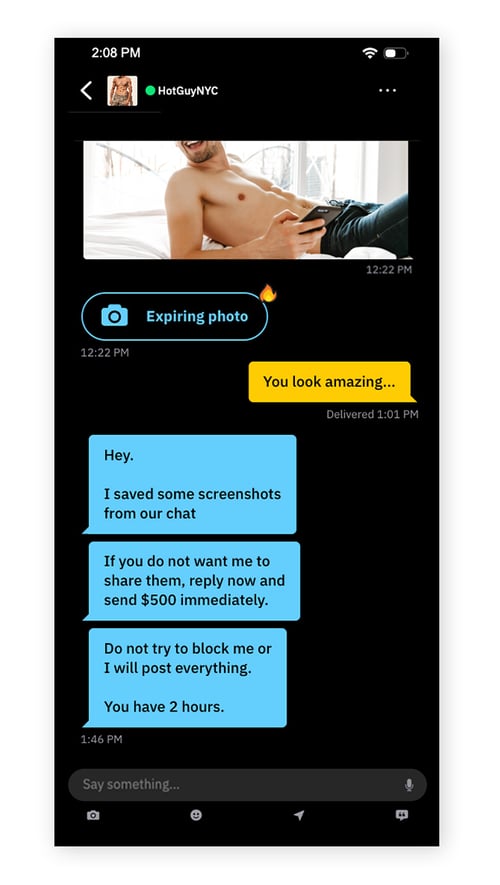
Money is often sextortionists’ ultimate goal. In one reported case, a man was asked for $1,000 in gift cards to prevent intimate photos from being shared on Facebook, while another was manipulated into sending thousands of dollars through CashApp.
But demands aren’t always financial. Scammers may pressure victims into sending additional explicit content or creating online accounts that can be exploited as part of other fraudulent schemes.
Sugar daddy fraud
Sugar daddy scams lure victims with promises of gifts, money, or a regular allowance. The scammer poses on Grindr as a wealthy “sugar daddy” looking for a “sugar baby,” sometimes promising thousands of dollars per week.
Before sending anything, however, they often ask for an upfront payment disguised as a verification charge, processing fee, or “loyalty fee.” But once payment is made, the scammer typically disappears. The scam could also escalate into sextortion if the scammer requests explicit photos or videos as “proof of loyalty,” then threatens to share them unless you pay more.
The “pay-before-you-meet” trap
Pay-before-you-meet scams on Grindr are a form of pretexting in which scammers posing as romantic interests invent a plausible reason for you to send money before meeting in person. After arranging a meetup, they might ask for money for gas, a hotel room, or a supposed “safety verification” fee before a hookup.
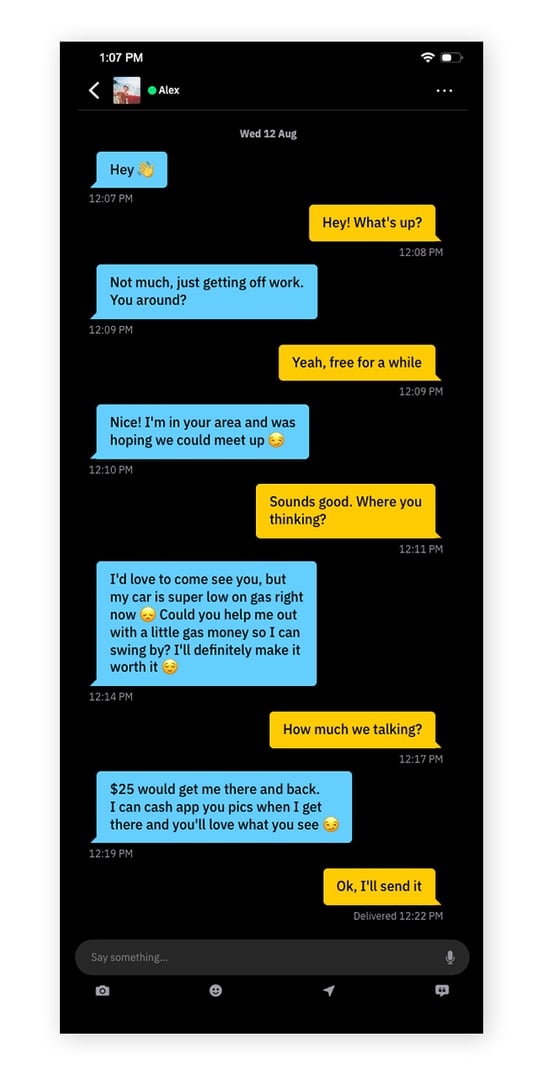
One Reddit user reported being asked to bring a $50 gaming gift card supposedly intended for the other person's son. But, as in the example above, once money or a gift card is sent, the scammer typically provides a fake meeting location and then stops responding, or simply disappears entirely.
Verification code theft
Verification code scams are designed to hijack your accounts or create fraudulent accounts using your identity. A scammer may ask you to share a code to prove you’re a real person rather than a Grindr bot. Soon afterward, you receive a two-factor authentication (2FA) code by text or email. But the scammer has actually triggered the code while trying to access or register an account using your information. Share it, and you may give them access.
Beyond compromising your accounts, stolen verification codes can increase your risk of identity theft, especially if the scammer already has personal information such as your name, phone number, or email address.
Investment scams
Investment scams on Grindr and other dating apps typically begin with a romantic connection. Once trust has been established, the scammer introduces a supposedly lucrative investment opportunity, often involving cryptocurrency.
Rather than disappearing after the first payment, scammers may show fabricated profits to convince victims to invest increasingly large amounts. This form of long-term manipulation is commonly known as “ pig butchering.”
The fraud becomes clear when the victim tries to withdraw their supposed returns. Withdrawals may be blocked or subjected to additional “fees” because, in reality, the money was never legitimately invested.
Red flags: how to spot a scammer
Scammers use fake identities, emotional manipulation, and urgency to make their profiles and requests seem convincing. Recognizing these tactics early can help you avoid Grindr scams and bots before you share sensitive information, intimate content, or money.
Here are the top Grindr scam red flags to look for:
-
Requests to send or receive money: Be wary of anyone asking for money, gift cards, crypto, or help receiving or transferring funds.
-
Requests for personal information: Scammers may ask for sensitive details under the guise of verifying your identity, then use them for fraud, blackmail, or identity theft.
-
Too-perfect profiles: Highly polished photos, impressive claims, and sparse personal details can indicate a fake or stolen identity.
-
Location hidden or inconsistent: Someone who claims to be nearby but hides their distance or gives conflicting location details may not be where they say they are.
-
Profile inconsistencies: Their photos, age, location, job, or personal story may contradict one another.
-
Love bombing: Excessive affection, compliments, or talk of a relationship very early on can be an attempt to manufacture trust quickly.
-
Avoiding meetups or video calls: Repeated excuses for not meeting or appearing on camera may indicate they're using stolen or AI-generated photos.
-
Investment pitches: Treat unsolicited crypto or investment opportunities from dating-app matches as a major warning sign.
-
Urgent requests: Scammers create artificial deadlines and emergencies to pressure you into acting before you can verify their story.
-
Early requests for explicit content: Someone pushing for intimate photos or videos immediately may be gathering material for sextortion.
-
Pressure to move to another app: Moving quickly to WhatsApp, Telegram, or another platform can make it harder to report suspicious behavior through Grindr's built-in tools.
Common red flag messages
Scam messages can be harder to recognize in the middle of a conversation, but certain phrases and requests should immediately raise suspicion. Watch for messages like these on Grindr:
-
“I'll be your sugar daddy and pay you $10,000. Message me on Telegram.” Promises of large allowances paired with an immediate request to switch platforms are a common sugar daddy scam tactic.
-
“Add me on WhatsApp. I’m rarely on here.” Moving the conversation off Grindr quickly can help scammers avoid the platform’s reporting and moderation tools.
-
“If you want to talk somewhere more private, let me know.” Be cautious when someone pushes to move to another messaging app early in the conversation.
-
“I work in finance and trade crypto on the side. What do you do?” Unprompted references to investing or cryptocurrency can be an early sign of an investment scam unfolding.
-
“I’ve been attacked before, so please complete this $2 safety verification.” Requests to pay for third-party verification services are a major red flag.
-
“Let's meet at a hotel. Can you pay half upfront?” Requests for money before you've met can indicate a pay-before-you-meet scam.
Grindr safety guide and features
Grindr can be a great way to meet new people, but staying safe requires protecting your privacy and knowing how to respond to suspicious behavior. These tips can help you avoid scams and reduce your exposure to other risks:
-
Never send money to someone you haven’t met: Requests for gift cards, crypto, verification fees, travel expenses, or emergency payments are major scam red flags.
-
Limit location sharing: Avoid revealing your precise location or other details that could help someone identify where you live or work.
-
Ask for a video call: Before sharing sensitive information or intimate photos, suggest a quick in-app video call. Repeated excuses for avoiding one can be a warning sign.
-
Look for “Taken on Grindr”: Photos captured through Grindr's in-app camera may carry a “Taken on Grindr” watermark, providing additional context about where the image originated.
-
Be cautious with links: Unexpected links can lead to phishing sites, fake verification pages, or websites designed to distribute malware.
-
Protect personal information: Avoid sharing your full name, address, phone number, workplace, or other identifying details early in a conversation.
-
Think carefully before sharing intimate content: Verify who you’re talking to first, and avoid including your face, distinctive tattoos, documents, or identifiable surroundings if you choose to share explicit images.
-
Check suspicious profile photos: Use a reverse image search to see whether someone’s pictures appear elsewhere online under a different identity.
-
Use Grindr’s block and report tools: Block users who make you uncomfortable and report accounts you believe are involved in scams, harassment, or other abusive behavior.
-
Trust your instincts: If someone's story doesn’t add up, they pressure you to act quickly, or the interaction simply feels wrong, stop engaging.
What to do if you’ve been scammed or blackmailed
Being scammed or blackmailed on Grindr can be frightening, and scammers often use urgency and embarrassment to pressure you into acting quickly. Don’t pay up or give in to further demands. Instead, focus on cutting contact, preserving evidence, and reporting what happened.
Here’s what to do:
-
Stop communicating with the scammer: Block and report them on Grindr and any other platforms they’ve contacted you through. Don’t pay a ransom — payment won’t guarantee the threats will stop and may lead to further demands.
-
Preserve evidence: Take screenshots of conversations, profiles, usernames, threats, payment requests, transaction details, and anything else that could help identify the scammer. Don’t delete your chats until you’ve saved what you need.
-
Report the incident to the authorities: File a report with the Internet Crime Center (IC3). If you’re being directly threatened or fear for your physical safety, contact local law enforcement immediately.
Protect yourself against scams today
Grindr scams can move quickly, but knowing the warning signs can help you stay ahead. Protect your privacy, limit what you share, verify people before meeting, and be cautious of anyone asking for money, personal information, or urgent action.
Avast One adds another layer of protection by helping block malicious links and fake websites, and monitoring for data breaches that could expose your personal information. Its AI-powered scam protection can also help you identify suspicious messages, giving you greater confidence as you connect online.
FAQ
How do I know if someone on Grindr is a bot?
Grindr bots often have sparse or inconsistent profiles, generic bios, suspicious photos, or messages that don't respond naturally to what you say. A major red flag is receiving an unsolicited link early in the conversation, particularly one leading to a verification page or external website.
Can a scammer hack my phone just by me replying to them?
No, simply replying to a message isn’t enough for a scammer to hack your phone. However, responding can confirm that your account is active, potentially attracting further scam attempts. And you are putting yourself at risk if you share sensitive information, click malicious links, download files, or reveal login or verification codes.
What are the area codes to avoid on Grindr?
While international country codes like +234 (Nigeria), +232 (Sierra Leone), and +63 (Philippines) are frequently associated with phone and text message scams, no particular area code reliably identifies a Grindr scammer.
Cybercriminals can use VoIP services, spoofed numbers, or virtual phone numbers to appear as though they’re calling or messaging from almost anywhere. Instead of relying on an area code, look for behavioral warning signs such as requests for money, verification codes, personal information, or urgent action.
How can I verify if a person is real without giving my number?
Use Grindr’s in-app video calling feature so you don't have to share your phone number or move to another platform. If the person appears to match their profile and interacts naturally on camera, that’s a positive sign — but not a guarantee they’re trustworthy. Keep looking for other red flags as the conversation develops.
What customers say

More Security Articles

The AI Confidence Trap: Most People Think They Can Spot AI Content. Scams Are Still Getting Through

How To Work With Your Grandparents To Keep Them Safe From Scams
Grindr Scams: How to Spot Sextortion and Stay Safe

Brushing Scams: What Are They and How Do They Work?

What is the Nigerian Prince scam?

Block Mobile Scams Instantly with AI-Powered Scam Guardian Pro

How to Avoid eBay Scams: A Comprehensive Guide
How to Spot and Avoid Fake Emails Supposedly from Avast
Is Ticketmaster Legit?
Scam Likely Calls: What Are They and How Can You Block Them
Signal App Scams: How to Identify Them and Protect Yourself

How to Spot and Avoid Airbnb Scams
Scams
Security
Ben Gorman
18-08-2026