- Security
- Privacy
- Performance
The Poshmark e-commerce platform attracts millions of users hunting for deals on fashion, beauty, and home goods — but like any marketplace, it comes with risks. While Poshmark is legit, you can still encounter scams and buyer–seller disputes. Learn smart habits for shopping and selling safely, including using trusted cybersecurity software.






This Article Contains
This Article Contains
What is Poshmark?
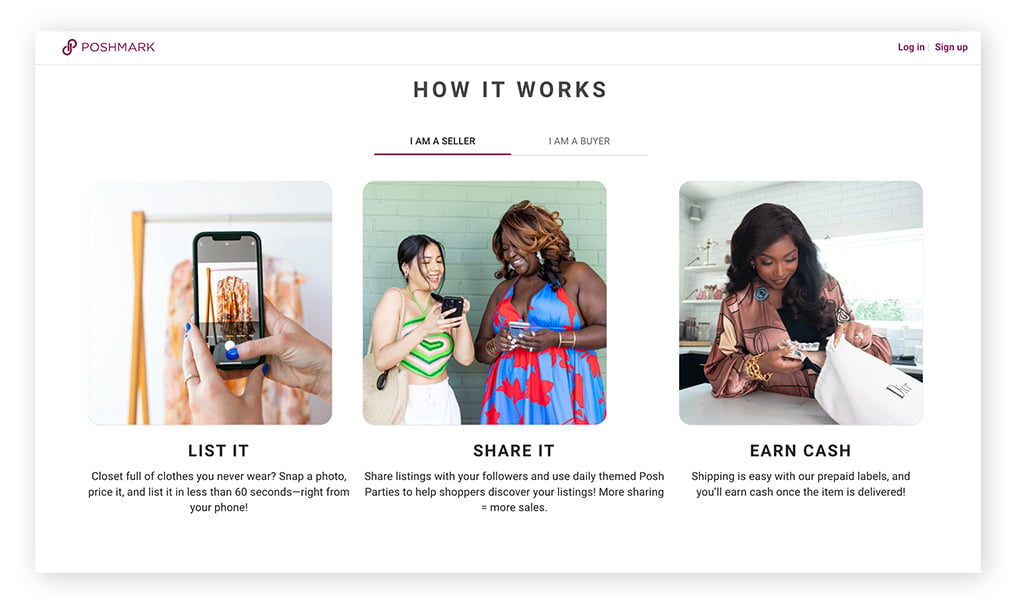
Poshmark is an online marketplace where people buy and sell new or secondhand clothing, accessories, home goods, beauty items, and even electronics. Users list items from their own closets, browse curated fashion listings, and earn money by reselling brands through the app or website.
But unlike Etsy and other online marketplaces, Poshmark is built around “social commerce,” meaning users don’t just shop — they follow sellers, share listings, leave likes, and even write “love notes” to celebrate exceptional purchases. Think Facebook for shoppers. The platform is also known for its commitment to sustainability, encouraging people to give clothing and household items a second life, rather than buying new.
This community and earth-loving feel are a big part of the platform’s popularity and rapid growth. From humble beginnings in a California garage in 2011, it quickly morphed into an e-commerce behemoth. The platform now boasts a community of over 130 million members, and sellers have generated $8 billion in earnings.
How legit and trustworthy is Poshmark?
Poshmark is a legitimate company and generally considered safe to buy or sell on, as long as you follow basic safety guidelines.
In 2022, South Korean tech giant Naver Corporation — a multi-billion-dollar internet conglomerate known informally as “Korea’s Google” — acquired Poshmark for $1.2 billion. This suggests they likely saw long-term potential, a strong user base, and platform mechanics and a business model they trust. Nevertheless, user-experience guides and reviews are mixed.
Reviewers on Trustpilot often report feeling let down by the quality of products and poor customer service. Common criticisms on reviews.io highlight difficulties returning items, unexpected order cancellations, and also cite issues with customer service.
But many have found this e-commerce cloud has a silver lining. Vendoo found most reviews were positive, including a glowing review on Google Play: “I found a vintage designer handbag for a fraction of the price I would pay in-store!” The app also boasts an impressive 4.8-star rating on the App Store, with many customers praising the easy-to-use interface, great prices, and the active social community.
How reliable is Poshmark for buyers and sellers?
For the most part, Poshmark is considered reputable and trustworthy, but the same can’t be said of every buyer and seller. That’s why it’s important to keep all communication and transactions on the platform, where Poshmark’s security measures and buyer protections apply.
All online bazaars come with risks, from eBay mishaps to Facebook Marketplace scams. So understanding the platform’s rules and built-in protections — and using them as intended — is the best way to buy and sell safely.
 Posh Protect
Poshmark offers buyer protection through Posh Protect. If an item arrives damaged, counterfeit, incomplete, or not as described, you can open a case within three days of delivery. Poshmark will review photos of the issue and, if approved, provide a return label and full refund. After the three-day window, payment is released to the seller, so reporting problems quickly is essential.
It’s also important to understand what isn’t covered: items that don’t fit, buyer’s remorse, and anything bought or traded off-platform. In these cases, Poshmark won’t issue a refund, but you can resell the item yourself.
 Posh Authenticate
Is it really a Gucci handbag? For luxury items priced over $500, Poshmark offers Posh Authenticate, a free service designed to protect buyers from counterfeit goods. High-value pieces are either pre-authenticated by vetted suppliers or sent to Poshmark HQ, where experts check the logos, materials, stitching, tags, and overall quality.
Once approved, the item is shipped to you with a certificate of authenticity, giving shoppers extra confidence when buying expensive designer pieces.
 Secure payments
Poshmark states that “buying on Poshmark is extremely safe and secure.” That’s because payment information is encrypted, processed entirely by Poshmark, and never shared with individual sellers. You also don’t have to worry about paying for something that never arrives, since funds aren’t released to the seller until you confirm receipt.
 Identity verification
Poshmark asks buyers and sellers to provide basic details, such as a phone number, email, and address, when creating an account. For certain actions (like making big purchases, requesting refunds, or updating account information), Poshmark may also ask users to verify their identity with a government-issued ID and sometimes a face scan via their phone camera. These checks help reduce fraud and make sure the people you’re dealing with on the platform are real, legitimate users.
To make sure Poshmark’s protections work as intended, follow the rules: keep all communication and transactions within the app, use only official payment methods, upload accurate item photos if you’re selling, and act within required timelines.
Common Poshmark scams to watch out for
Even major online platforms aren’t immune to scams — Amazon scams exist, and Poshmark is no exception. With millions of legitimate buyers and sellers on the platform, it also attracts a small number of bad actors looking to take advantage. So if you’re wondering whether you can get scammed on Poshmark, the answer is, unfortunately, “yes.”
Knowing the red flags is the best way to stay one step ahead and shop with confidence.
Impersonation scams
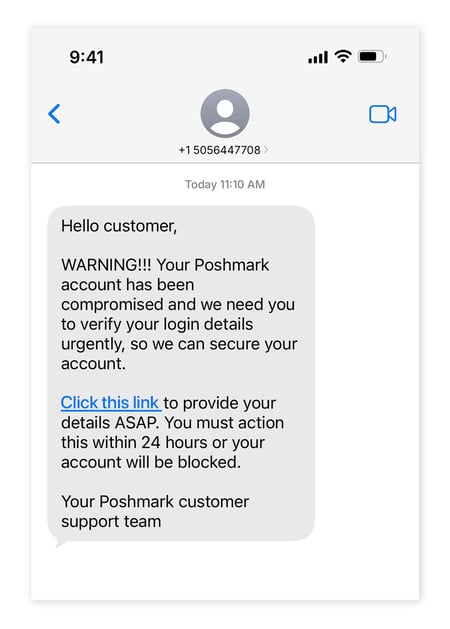
Scammers may pose as Poshmark support or a serious buyer, asking you to “verify” your account, “confirm” payment issues, or update your shipping information. Their goal is to trick you into revealing your password, personal details, or payment info, so they can take over your account, steal your identity, or access your funds.
Be cautious of messages that use urgent language or other social engineering tactics. Scammers often use spoofing to impersonate trusted brands like Poshmark, so don’t assume an email or text is legitimate just because it looks official.
Fake listings and counterfeit goods
Fake listings are designed to lure buyers into purchasing items that are counterfeit, damaged, or don’t exist at all. Spotting fakes means looking closely at logos, stitching, tags, and pricing. If a deal seems far below market value, that’s a red flag.
Always research seller profiles carefully and be cautious with accounts that have little or no transaction history. Check that the username and display name align, and watch out for blurry photos, missing brand tags, stock images, or overly polished photos reused across multiple listings.
Payment scams and phishing emails
Scammers may try to move the deal off-platform by suggesting you use a cash-transfer service. This tactic is often linked to Cash App scams and other peer-to-peer payment apps.
Sellers should also watch for fake payment confirmations meant to trick them into shipping items that haven’t actually been paid for. Another variation is the swap scam, where a buyer receives an authentic item and returns a counterfeit version. Without clear documentation of the item and packing process, sellers may be left with fake goods and no payout.
Phishing emails are another common threat. These messages mimic official Poshmark communications but often include subtle clues, such as slightly altered sender addresses, off-brand colors, or awkward wording. They may contain links to fake login pages, malware downloads, or requests for sensitive information to “complete a transaction.”
Cybersecurity tools like Avast Free Antivirus add a powerful layer of extra protection for online shoppers by blocking malicious websites, phishing links, and malware. And thanks to AI-powered scam detection can also help you evaluate suspicious Poshmark messages when you’re unsure.
Account takeovers and chargeback fraud
Account takeover scams often begin with reused passwords exposed in data breaches or phishing attempts that capture your login details. Once inside your account, scammers can change contact information, redirect payouts, or make unauthorized purchases.
Chargeback fraud is another risk for sellers. In these cases, a buyer receives an item and then falsely claims the transaction was unauthorized. The result can be a lost item, a reversed payment, and little recourse if proper documentation isn’t in place.
How to stay safe on Poshmark
Poshmark comes with risks for both buyers and sellers. Still, you can shop with confidence from trustworthy sellers, provided you follow a few smart habits and stay vigilant. Stick to the rules and stay on the platform for all transactions (including messaging and payments). Poshmark can’t protect you if you wander off into a digital wilderness.
For a safer experience, always remember the basics: Use a unique, strong password, enable two-factor authentication, and never click unexpected login links sent by text or email. And don’t be an “over-sharer” — that person who sends screenshots of balances, shares order IDs, or personal details publicly.
Tips for buyers
Stay on Poshmark’s secure system and avoid any offers to pay outside the app. No matter how tempting an item, take a moment to research the seller, read reviews, and verify that the listing is genuine. A little caution goes a long way.
DO:

Check seller ratings, reviews, and past sales.
-
Look closely at photos, tags, and item descriptions.
-
Ask questions if something looks unclear or inconsistent.
-
Use Poshmark’s built-in payment methods only.
-
Report suspicious messages or listings immediately.
-
Inspect items within 3 days and open a case via Posh Protect if needed.
AVOID:

Suspiciously low prices.
-
Multiple listings with the same item.
-
Blurry, stock images, or photos stolen from other sites.
-
Requests to move off-platform, whether they’re emails, texts, or requests to complete sales via apps like Zelle or Cash App.
-
Links in comments or DMs that lead off the Poshmark platform.
-
Empty or new accounts with no love notes, followers, or history — take extra time to verify these.
Tips for sellers
Selling on Poshmark is generally reliable, but only if you keep every step of the process on the platform. The biggest risks come from off-platform payment requests, fake payment confirmations, and disputes without proper proof. Thorough documentation and careful shipping practices are your best defenses if a buyer files a fraudulent claim.
DO:
-
Document everything — photograph the item’s condition, tags, the packaging, and the shipping label.
-
Keep tracking details and proof of drop-off in case a buyer reports non-delivery.
-
Ship only to the address on the official Poshmark label and refuse any requests to send a parcel elsewhere.
-
Verify unusual buyer requests and report anything that feels off.
NEVER:
-
Ship before the sale appears in “My Sales” with a genuine Poshmark shipping label.
-
Agree to off-platform payments, as this removes your protections entirely.
-
Respond to requests for personal information. Scam fraudsters sometimes falsely insist that the platform won’t process their payment unless they provide the seller’s phone number or details.
Help protect yourself with Avast
Poshmark includes helpful protections, but staying safe also depends on how well you protect yourself. Avast Free Antivirus helps defend against phishing links, fake login pages, and other online threats that commonly target shoppers and sellers.
By blocking scams and malicious activity before they cause harm, Avast Free Antivirus lets you browse, buy, and sell with more confidence. Download an award-winning cybersecurity app today and stay better protected from evolving threats — while focusing on scoring that designer find.
FAQs
Is Poshmark safe to buy from?
Yes, Poshmark is generally considered trustworthy, thanks to protections like Posh Protect, which covers items that arrive damaged, incorrect, or not as described. To stay safe, use in-app payments only, review seller ratings carefully, and inspect your order within the three-day acceptance window. Avoid requests to move off-platform and report anything suspicious immediately.
Can you get scammed on Poshmark as a buyer?
Yes, buyers can be scammed, most commonly through fake or counterfeit listings or phishing attempts. Protect yourself by keeping all payments and messages on the platform, reviewing the seller’s history, and watching for red flags like stock photos or prices that seem too good to be true. Inspect your item as soon as it arrives so you can open a Posh Protect case if needed.
Can you get scammed on Poshmark as a seller?
Yes, it’s possible, but following Poshmark’s rules significantly reduces the risk. Common scams include fake payment confirmations, off-platform payment requests, and fraudulent returns. Only ship items that appear in your “My Sales” tab with an official Poshmark label, document items before shipping, and decline any request to communicate or transact outside the app.
Poshmark is owned by Naver Corporation.
What customers say

More Security Articles
Phantom Deal: Inside an Imposter Scam Targeting an Avast Employee
What Is UPnP?
Why is My iPhone in SOS Mode?
New Avast One vs Legacy Avast One: What’s Changed?
What Is the New Avast One?

Is Mercari legit? A guide to safe shopping and avoiding scams

Is WeTransfer Safe?
Is Poshmark Legit?
Is WhatsApp Safe?
Is Apple Pay Safe?
How to Bypass Apple Activation Lock (and Which Methods to Avoid)

Is Windows 10 Still Supported? It Is by Avast
Security Tips
Security
Nicola Massier-Dhillon
13-02-2026