- Security
- Privacy
- Performance
Are you trying to watch your favorite TV show and movie while traveling internationally, or bypass bandwidth throttling on your smart TV? Learn how to use a VPN to stream content more securely, find the best VPN for international streaming, and understand what you need to know about watching content with a VPN legally.




This Article Contains
This Article Contains
How to watch international TV and movies with a VPN
A VPN can let you access streaming services from another country by routing your connection through a server there. Once connected, the streaming service sees a local IP address and serves its regional catalogue — the same one available to viewers in that country.
 Using a VPN can help you stream shows while traveling abroad.
Here's a closer look at how to find your title, change your IP address with a VPN, and start streaming:
1. Find your content and confirm access
Before connecting to a VPN, figure out which service carries the title you want and in which countries it’s available. Here’s how:
-
Search for the title: Google the name plus "where to watch," or use JustWatch to check availability by country. Switch the country filter to compare catalogues side by side.
-
Confirm on the streaming service's own site: Third-party listings usually lag behind real catalogue changes, so treat them as a starting point, not a guarantee.
-
Check the platform's Terms of Use: Some streaming services explicitly prohibit using VPNs to unlock geo-blocked content and may actively detect and block VPN traffic. For services you already subscribe to, a VPN alone may be enough to unlock another region's catalogue. But if the content’s on a platform not offered in your home country, you'll typically need a local account (and sometimes a local payment method) to sign up in the first place. Always check the platform’s terms before subscribing to a VPN or paying for content.
2. Set up your VPN
Install a reputable VPN app on your device, sign in, and connect. This general process is largely the same whether you're on a phone, computer, or streaming device, though the exact steps vary by platform.
-
Choose a VPN: Look for a reputable provider with strong reviews, a clear privacy policy, and servers in the countries you plan to use. Avoid completely free VPNs with sketchy or vague ownership or privacy practices, as some may collect or monetize your data.
-
Download and install the app: Download the VPN directly from the provider's official website or your device's app store to avoid fake or malicious copies.
-
Create an account and subscribe: Most VPNs require a paid subscription. Choose a plan, create your account, and complete payment before signing in.
-
Sign in and set up: Log in with your account, then finish setting up your VPN . For example, the app may need permission to add or configure a VPN profile on your device.
3. Choose the location
Now it’s time to change your virtual location by connecting to a VPN server in the country whose catalog you want to access. For example, the UK for BBC content, the US for American streaming libraries, or Japan for Japanese services. Keep in mind that obscuring your real location violates some streaming platforms’ terms, and overall VPN use may be restricted or regulated in some countries.
Server distance also matters. Connecting to a server farther away from where you actually are generally increases latency and may reduce streaming speeds, so choose the closest suitable server when possible. Once you’re connected, open the streaming service’s app or website, search for your title, and start watching.
If you encounter a proxy error or the expected content doesn't appear, try rotating your IP address or switching to a different server within the same country.
How to use a VPN on a smart TV
The easiest way to use a VPN on a smart TV is through a native VPN app. TVs and streaming devices running Android TV, Fire OS (Amazon Fire TV), or tvOS (Apple TV) may support direct installation of compatible VPN apps. For unsupported models, you may need to use an alternative setup method.
1. Verify VPN compatibility
First, check whether your VPN is compatible with your smart TV. This will likely depend on its specific model, operating system, age, region, and manufacturer support.
To do this, confirm your TV is online by going to Settings >Network >Connection(or Internet), and connecting via Wi-Fi or Ethernet if necessary. Then open your TV's official app store and search for your chosen VPN provider by name.
What if your preferred VPN isn’t available on your TV?
If your VPN’s not listed in your TV’s app store, don't be tempted to sideload an unofficial app or APK — this is a common way malware infects smart TVs.
Try these safe workarounds instead:
-
Update and retry: Install any pending TV software updates, restart your TV, and search the app store again using the VPN’s full product name.
-
Install the VPN on your router: If your VPN supports router installation, you can set up the VPN there instead, then configure your smart TV’s connection directly via your router.
-
Cast from another device: Connect to the VPN on your phone, tablet, or computer, then stream content to your TV using AirPlay, Google Cast, or another supported screen-mirroring feature.
-
Plug in a compatible streaming device: Plug in a supported device such as a Fire TV Stick, Apple TV, or Android TV/Google TV box, and connect it to your TV's HDMI port. Install and connect the VPN on that device, then stream through its apps instead of your TV's built-in ones.
2. Set up your VPN app
If your chosen VPN is available in your TV’s official app store, follow these installation steps to get it set up:
-
Select the VPN in your TV's app store and download it.
-
Open the app from your TV's app menu.
-
Sign in with your VPN credentials, or use a pairing/activation code if the app offers one.
-
Approve any connection permissions the TV requests to allow the VPN to route your traffic.
If you're sharing a connection from another device instead, install and connect a VPN on your PC, Mac, iPhone, or Android, then link that device to your TV via a streaming stick, shared network, or screen-mirroring.
3. Connect to a server
Choose a VPN server location based on where you are and what you want to watch. Server distance can affect performance, so connecting to a nearby server usually means better speeds and lower latency. But if you want to access content from another country or region, you’ll need to choose a server in that locale. For example, you’ll need a UK server for BBC content and a US server to access Hulu.
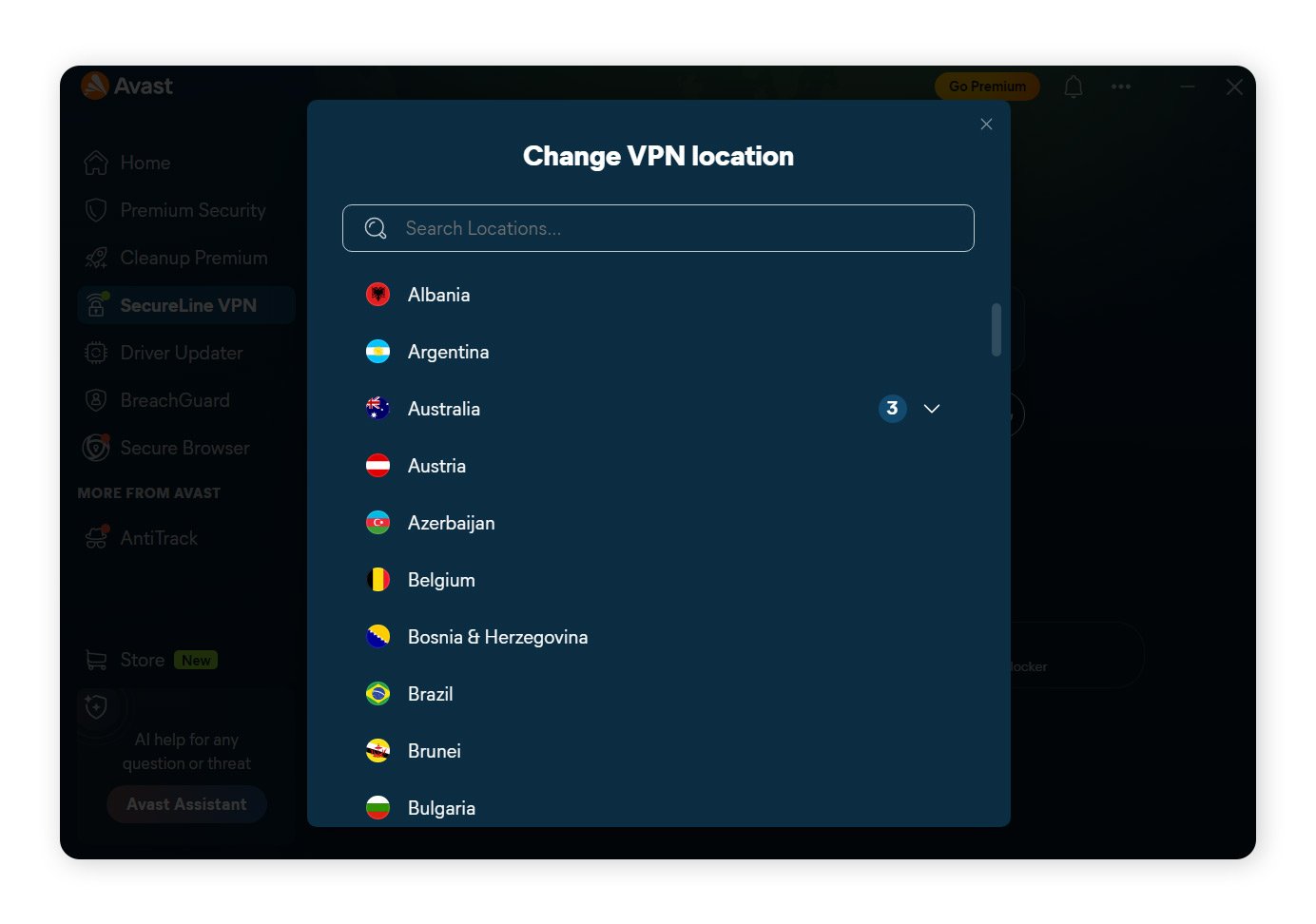 SecureLine VPN has over 100 global VPN server locations to choose from.
Once you’ve chosen a location, select Connect and wait for the VPN to confirm the connection before opening your streaming app. Keep in mind that changing your apparent location may violate some streaming services’ terms. It’s best to check the service's Terms of Use document before connecting.
4. Stream your favorite TV shows
Once you’ve connected to a server via the VPN on your TV or chosen sharing device, open your streaming app and browse as normal — it should now reflect the catalogue for your selected region. Availability varies by service and licensing:
-
On-demand platforms like Netflix, Prime Video, Disney+, and Max carry different titles in different countries due to licensing.
-
US-only services such as Hulu, Peacock, and ESPN Select typically require a US-based account and payment method in addition to a US server.
-
Live and user-generated platforms like YouTube and Twitch may also vary by region.
If you see a proxy error or the content doesn't load, try a different server in the same country and restart the streaming app.
How does a VPN work for streaming?
A VPN encrypts your internet traffic and routes it through a secure remote server before connecting to a streaming service. This helps protect the data you send and receive, mask your IP address, and add privacy to your connection, which can be especially useful when streaming on public or shared Wi-Fi.
Here is how a VPN works for streaming:
-
You connect to the VPN: Open your VPN app and select a server.
-
The VPN encrypts your traffic: Your internet data is encrypted, making it harder for others on the network to intercept or read.
-
Your traffic passes through the VPN server: The VPN server forwards your requests to the streaming service.
-
Your IP address is masked: The streaming service sees the VPN server’s IP address rather than your own and determines your location from it.
-
The video streams back to your device: The streaming data travels back through the VPN connection for playback.
The set of rules and procedures governing this process is known as a VPN protocol, and the specific protocol being used can also affect streaming performance. Modern protocols such as WireGuard, Lightway, and NordLynx are designed for fast, efficient connections.
Some advanced protocols, such as Avast’s proprietary Mimic protocol, even obfuscate your connection, helping to hide the fact that you’re using a VPN in the first place.
Is it legal to use a VPN to watch TV?
Generally, it’s legal to use a VPN to watch foreign TV and other online content, provided the content itself is legal where you are. VPN use is legal in the US and most other countries, whether you’re streaming or using one for privacy or security. However, laws vary, so check local VPN regulations before traveling abroad.
Using a VPN to access region-restricted content may also violate a streaming service’s terms, even if it isn’t outright illegal. If the platform detects VPN usage, it may block playback or restrict access. Repeatedly violating a service’s terms could also put your account at risk of suspension or termination.
Do streaming services ban you for using a VPN?
Streaming services rarely ban accounts outright for VPN use, but many do attempt to block known VPN IP addresses. Some platforms, including Amazon Prime Video, expressly forbid using a VPN or any other tool to disguise your location, and reserve the right to ban accounts that break their terms of service.
But, depending on the platform, VPN usage is more likely to result in:
-
A VPN or proxy error preventing you from streaming.
-
The VPN server’s IP address being blocked by the platform.
-
A more limited content library of global releases while the VPN is connected.
-
Certain live or regional content becoming unavailable.
For example, Netflix states that when you use a VPN, it may only show titles for which it holds worldwide rights, while ad-supported plans do not allow VPN streaming. If in doubt, check the platform’s current policy and your specific subscription rules, and adhere to the terms of use.
Do you need a VPN for streaming?
Whether you need a VPN for streaming depends on how and where you watch. But for most people, a VPN offers the best all-round combination of privacy, performance, and flexibility, even when it isn't strictly essential. It encrypts your connection, keeps your streaming activity private, and can ease some forms of ISP throttling — all while letting you change your virtual location at the click of a button.
But if your main goal is watching online TV shows that aren’t available in your current location, there are alternatives to a full VPN to consider, including:
-
Smart DNS: Changes how your DNS requests are routed and can work on devices that don’t support VPN apps, including some smart TVs and gaming consoles. But unlike a VPN, this generally doesn’t encrypt your internet traffic.
-
Control D: A DNS-based service that can route certain traffic through proxy locations, allowing supported services to see a different location without using a traditional VPN connection.
-
VPN browser extensions: If you stream through a browser, a VPN browser extension can offer a convenient way to route browser traffic without running a full VPN app.
-
Standalone proxy servers: Similar to a VPN, an HTTP or SOCKS proxy can reroute your traffic through another location, but typically lacks the security and privacy offered by VPN encryption.
Best VPN for TV streaming
For streaming, choose an established VPN provider with fast servers, strong encryption, a verified no-logs policy, and a native app for your TV or streaming device. A large server network and reliable customer support can also help maintain smooth, secure streaming.
Here are some of the best streaming VPN options out there with smart TV support:
-
SecureLine VPN: Offers a dedicated Android TV app with straightforward connections, encrypted traffic, DNS leak protection, and servers in multiple locations.
-
Norton VPN: Offers native apps for Google TV, Amazon Fire TV, and Apple TV, with support for the fast WireGuard protocol.
-
NordVPN: Offers apps for popular TV platforms, including Android TV, Google TV, Amazon Fire TV, and Apple TV.
-
ExpressVPN: Supports major TV and streaming platforms, including Android TV, Google TV, Amazon Fire TV, and Apple TV.
-
Surfshark: Supports Android TV, Google TV, Amazon Fire TV, and Apple TV and allows unlimited simultaneous connections, making it useful for multi-device households.
-
CyberGhost VPN: Offers dedicated apps for Android TV and Amazon Fire TV with a straightforward setup process.
-
IPVanish: Supports Android TV and Amazon Fire TV devices, including Fire TV Stick and Fire TV Cube.
Is a VPN worth it for streaming?
A VPN is one of the most effective tools for making streaming more private and secure. By encrypting your connection and masking your IP address, it can protect your viewing activity on public Wi-Fi, reduce certain types of ISP throttling, and provide a safer way to use streaming services while traveling.
Here’s why a VPN might be worth using for streaming:
 Protect your streaming activity: A VPN encrypts your internet traffic and masks your IP address, adding privacy when streaming — particularly on public Wi-Fi in hotels, airports, and cafés.
Use your usual services while traveling: Connecting through your home region may help you use your regular streaming subscriptions abroad, although availability depends on the platform’s terms and regional licensing.
Reduce some ISP throttling: If your ISP selectively slows certain types of high-bandwidth traffic, VPN encryption can make your specific activity harder to identify and target. However, a VPN cannot prevent congestion or other forms of network management.
Access different content libraries: A VPN can change the location associated with your IP address, potentially affecting which regional catalog a streaming service displays. However, many platforms restrict this practice under their terms and actively block VPN traffic.
Can I unblock streaming sites with a VPN?
A VPN may help unblock streaming sites by replacing your public IP address with that of a VPN server. This can help when a streaming service is unavailable because of local network restrictions, such as blocks on hotel, school, or workplace Wi-Fi. Connecting through a server in another country may also change the regional content a platform shows, including on services such as Netflix, Hulu, Disney+, BBC iPlayer, and Max.
However, streaming providers may detect and block VPN connections, and using a VPN to bypass geographic restrictions can violate their terms of service. The same considerations apply to regional live TV and sports broadcasts.
Get a VPN for streaming your favorite TV shows
Not all VPNs are built with streaming in mind. Some can drag down speeds, limit bandwidth, or struggle with streaming, while others combine fast servers, broad location coverage, and stable performance to help you watch with fewer interruptions.
SecureLine VPN offers 100+ high-speed server locations all around the globe, with ironclad AES-256 encryption and one-click connections to help you stream more privately from supported locations. Start your free trial today to securely stream the shows you love.
What customers say

More Privacy Articles

Avast expands SecureLine VPN with Double VPN, IP Rotation, and more
Are free VPNs safe?

Can You Be Tracked While Using a VPN?

What Is VPN Split Tunneling?
VPN Kill Switch: What It Is and Why It Matters

What Is a Replay Attack and How Does It Work?

How to Fix The “Connected Without Internet” Wi-Fi Issue

Understanding AES Encryption: What Is the Advanced Encryption Standard?

Is Telegram Safe? A Guide to the Secure Messaging App
How to Encrypt Email on Gmail, Outlook, iOS, Android, and Other Platforms

VPN Protocols Explained and Compared

How to Use a VPN for Streaming TV Shows and Movies
VPN
Privacy
Oliver Buxton
16-06-2023